
> Definition: Fear of flying recovery is the process of systematically retraining your brain and body through education, therapy, and graduated exposure so that air travel becomes a manageable routine rather than a crisis.
What Fear of Flying Really Is and Why It Persists
Fear of flying is a specific phobia when air travel triggers intense fear, avoidance, or distress that is out of proportion to the actual risk. In a 2016 U.S. survey, about 12.5% of adults reported fear of flying, and 2.5% met criteria for flying phobia source.
The problem usually persists through an avoidance loop. You feel dread, avoid the flight, feel short-term relief, and your brain learns that avoiding planes “kept you safe.” Next time, the threat alarm gets louder. The night-before airline app refresh, especially before a 6:40 a.m. flight, can become part of the loop.
Common triggers include takeoff acceleration, turbulence, the enclosed cabin, loss of control, and being far from help. For some people, the flight is not the only issue. Panic disorder, claustrophobia, PTSD, OCD, or health anxiety may be feeding the fear underneath.
That part matters.
5 Facts Every Nervous Flyer Must Know Before Starting Recovery
- Fear of flying is common and treatable. CBT and exposure therapy have strong evidence for specific phobias, including flying fear, and recovery does not require you to “like” flying.
- Aviation safety education reduces catastrophic thinking. Learning what turbulence, engine sounds, banking turns, and landing noises actually mean gives your brain fewer blanks to fill with disaster stories.
- Repeated exposure drives lasting change. Avoidance keeps the alarm system sensitive; planned exposure teaches your body that anxiety can rise, peak, and fall without escape.
- In-flight coping tools help during recovery. Breathing, grounding, scripts, and structured distractions can lower acute anxiety enough to keep you engaged with the plan.
- Underlying conditions often decide the pace. Panic, PTSD, claustrophobia, or fear of losing control may need direct treatment before flight anxiety improves.
A good comprehensive fear of flying resource should explain causes, treatments, coping strategies, and tools for nervous flyers, not just hand you a breathing trick for boarding day.
How Fear of Flying Recovery Works: The Brain-Body Mechanism
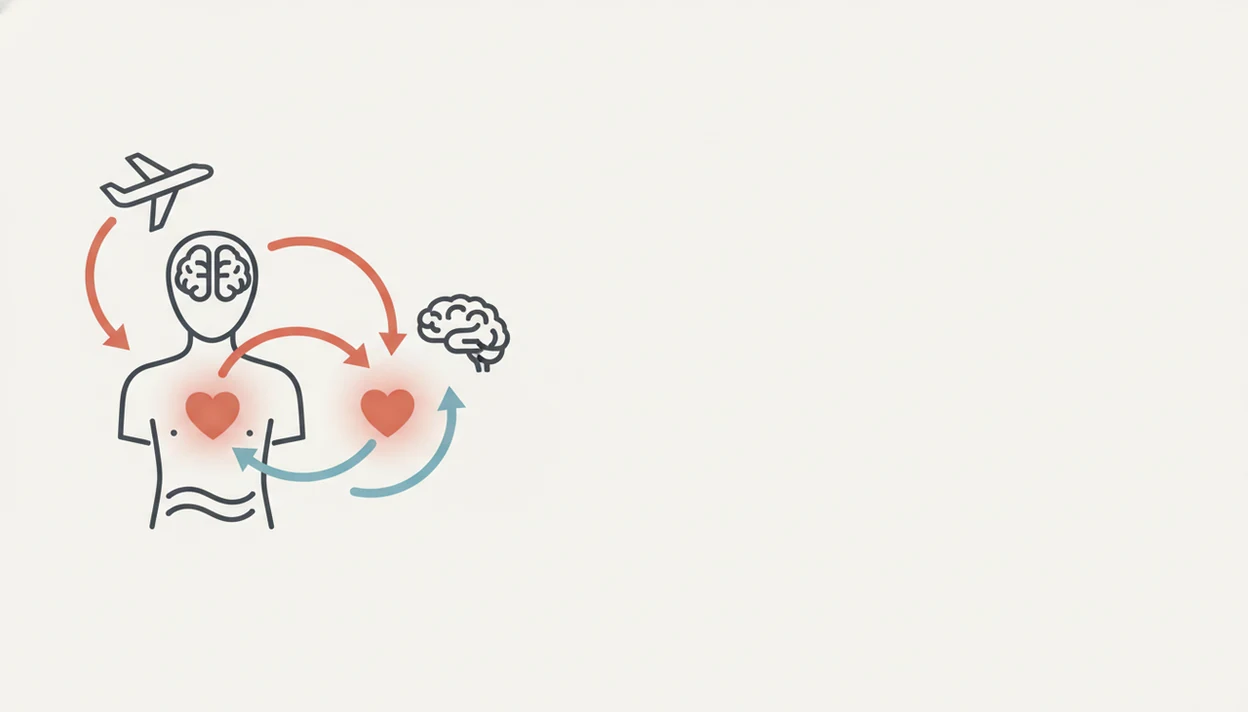
How does fear of flying recovery work? It works by teaching the amygdala, the brain’s threat detector, that flight-related cues are uncomfortable but not dangerous. The amygdala can misfire at safe stimuli, like a boarding call, a cabin door closing, or engines spooling for takeoff.
Recovery uses two learning processes. Habituation means your anxiety often drops after repeated contact with the trigger. Inhibitory learning means your brain forms a new memory: “I felt fear, and nothing dangerous happened.” That new memory competes with the old alarm memory.
CBT adds cognitive restructuring. You replace predictions like “turbulence will crash the plane” with evidence-based appraisals, such as “turbulence is uncomfortable air movement, and aircraft are built for it.” Exposure-based treatments for specific phobias show large effects in meta-analytic reviews, with some analyses reporting effects around g = 1.0 or higher source.
The most common medically supported way to reduce phobic avoidance is gradual exposure combined with CBT skills.
Requirements Before You Start Your Fear of Flying Recovery Plan
Before you start, assess three things: fear severity, avoidance patterns, and co-occurring conditions. Write down what you avoid, what you endure with panic, and what you need to do in the next six months. A wedding flight feels different from a weekly work route.
Decide whether self-help is enough. Mild to moderate fear may respond to a structured plan, especially if you can still board. Severe avoidance, panic attacks, PTSD symptoms, or a history of traumatic flight experiences are good reasons to consult a mental health professional.
Pack this before you leave the planning stage: an anxiety journal, a breathing app or timer, aviation education resources, and a Notes app coping card. Add one if-then script. Example: “If I feel trapped at the gate, then I will stand, exhale slowly, and name five blue objects.”
Set the goal correctly. You are building manageable flying, not zero anxiety.
Who This Fear of Flying Roadmap Is For
This roadmap is for nervous flyers who want a realistic next step, whether that means self-help, a structured guide, or clinician-led therapy. The right path depends less on how “brave” you are and more on how much flying fear is disrupting your life.
- Use self-help first if you still board flights but dread them for days, monitor the weather obsessively, or grip the armrest through takeoff and turbulence.
- Choose a structured guide if you need a clear exposure ladder before booking, especially after months or years of avoidance.
- Slow the pace if you travel for work, fly with children, or are rebuilding confidence after a rough turbulence experience; each situation adds different pressure.
- Get clinician support if panic attacks, PTSD symptoms, claustrophobia, dissociation, or fear of losing control make boarding feel unsafe or impossible.
- Match the tool to severity: Fear of Flying Guide can be enough for mild to moderate fear when you can practice steadily, while therapy is safer when symptoms are severe, trauma-linked, or escalating.
Step 1 — Learn Aviation Safety to Overcome Fear of Flying Misconceptions
Does aviation safety education help overcome fear of flying misconceptions? Yes, because it replaces mystery with specific explanations. Commercial aviation’s fatality rate has been reported at about 0.07 deaths per 10 billion passenger-miles, compared with 7.3 for cars, according to U.S. transportation risk data from the Bureau of Transportation Statistics source.
Start with turbulence. Turbulence is usually uneven air movement, not a sign the aircraft is failing. Planes are engineered for forces far beyond normal bumpy air, though your stomach may still hate the sudden drop feeling.
Then learn normal flight sensations. Takeoff can include acceleration, engine changes, gear retraction, and reduced climb thrust. Landing can include flaps, bumps, braking, and reverse thrust. These are procedures, not emergencies.
Useful resources include pilot Q&A content, Cockpit Confidential, and FlightRadar24 for context. Watching normal flights move across a map can make the system feel less invisible.
Step 2 — Build CBT Skills to Get Over Fear of Flying Thought Patterns
How do CBT skills help you get over fear of flying thought patterns? CBT teaches you to notice anxious predictions, test them, and replace them with more accurate thoughts. It is not the same as asking for reassurance every ten minutes.
Start with three distortions: catastrophizing, probability overestimation, and emotional reasoning. “I feel terrified, so this must be dangerous” is emotional reasoning. “The plane shook, so something is wrong” is catastrophizing.
Use a thought record before you open the airline app. Write the anxious thought, evidence for it, evidence against it, and a balanced replacement. If your thought is “I will panic and lose control,” the replacement might be, “Panic feels awful, but it peaks and passes. I can stay seated and breathe.”
A randomized trial of Internet-based CBT for flying fear found that 83% of treated participants flew within one year, compared with 60% in the control group source.
Step 3 — Use Graduated Exposure to Get Over Fear of Flying Permanently

Graduated exposure helps you get over fear of flying by practicing flight-related triggers in planned steps, not by forcing one brutal flight and hoping it fixes everything. Use a fear ladder and rate each step with a SUDS score from 0 to 100.
- List triggers from easiest to hardest, such as flight videos, airport visits, boarding sounds, simulators, short flights, and longer flights.
- Rate each trigger with a SUDS score before, during, and after practice.
- Repeat one step until your fear drops or you learn you can handle it without escaping.
- Move up gradually to airport practice, simulator or VR work, then short real flights.
- Review the evidence after each exposure in your anxiety journal.
Structured exposure programs have reported substantial reductions in flying-anxiety scores at follow-up, but results vary by treatment format, severity, and whether exposure is therapist-guided. VR exposure is promising, but access, cost, and long-term research still vary. For people rebuilding after a rough flight, fear of flying after bad turbulence often needs a slower ladder.
Step 4 — Deploy In-Flight Coping Strategies During Fear of Flying Recovery
In-flight coping strategies are not the whole cure, but they keep your body steady enough to continue recovery. Choose tools before boarding, not when your damp fingers are already gripping the safety card.
Use slow diaphragmatic breathing. Box breathing works well: inhale for four, hold for four, exhale for four, hold for four. The 4-7-8 pattern can help too, but skip long holds if they make you lightheaded.
Add grounding. Try 5-4-3-2-1: name five things you see, four you feel, three you hear, two you smell, and one you taste. Gum in the front pocket helps with the last one.
Pair coping with CBT self-talk. “This bump is air movement, not danger.” “My body is doing adrenaline, not prophecy.” Use headphones, audiobooks, games, or a downloaded playlist. Avoid alcohol as a coping plan. It blocks learning and can worsen anxiety later.
Step 5 — Relapse Prevention and Long-Term Fear of Flying Recovery
Relapse prevention keeps flying from becoming rare, dramatic, and scary again. Schedule maintenance flights when possible, especially after your first successful trip. Avoidance creep is quiet; it sounds like “I’ll book the train just this once.”
After each flight, do a post-flight review. Write what went well, what triggered anxiety, what you did with your body, and what you want to practice next. The shaky laugh on the jet bridge counts as data. So does the first steady breath outside the terminal.
Different flyers need different relapse plans. Business travelers can use frequency as an advantage if they stop treating every flight as a test. Parents may need scripts that model calm for kids; more on that is covered in fear of flying for parents. Trauma survivors often need PTSD-informed exposure, not generic “just fly more” advice.
Functional flying is the target. Some residual anxiety may stay.
Common Myths That Stall Fear of Flying Recovery
Several myths keep nervous flyers stuck longer than necessary. The first is “My fear is too severe, so I should never fly.” Severe anxiety is common, and many people recover enough to fly regularly with the right support.
The second myth is “Turbulence means the plane is about to crash.” Turbulence is routine air movement. It can feel awful in your body, especially during a brief stomach drop, but it is not the same as structural danger.
The third myth is “Sedatives or alcohol are the best way to get over fear of flying.” Medication may have a limited role when prescribed by a clinician, but alcohol and unsupervised sedatives can impair you, increase risk, and prevent new learning.
The fourth myth is “One forced long flight will cure me forever.” White-knuckle flights often teach your brain that flying is survivable only through panic. Planned repetition teaches something better.
How to Use This Fear of Flying Recovery Roadmap
Use this roadmap as a six-step plan for your next five minutes, next week, and next flight. Make the plan boring on purpose. Boring is easier to repeat.
- Assess your fear severity and note panic, claustrophobia, PTSD, OCD, or avoidance patterns.
- Complete aviation safety education during week one, including turbulence, takeoff sounds, and landing sensations.
- Practice CBT thought records daily for two weeks before booking a flight.
- Build your exposure hierarchy and work through it over 4 to 8 weeks.
- Book a short flight and use breathing, grounding, self-talk, and structured distraction on board.
- Review and adjust within 24 hours, then schedule a maintenance flight within three months.
Tools like Fear of Flying Guide, SOAR, and Fly Confident can support different parts of this plan, but the sequence matters more than the logo. Fear of Flying Guide is best used as the structured roadmap layer: aviation education, CBT practice, exposure planning, and relapse prevention in one sequence. Use clinician-led therapy instead if panic attacks, PTSD symptoms, or avoidance are severe enough that you cannot board. If you want pacing details, the fear of flying recovery timeline breaks the weeks down.
Fear of Flying Guide vs Other Recovery Options
Fear of Flying Guide is best understood as a self-guided roadmap, not a replacement for every recovery option. SOAR, Fly Confident, therapy, and airline courses can all help, but they differ in cost, access, structure, and how much human support you receive.
- Choose a self-guided guide if you can still board, want a lower-cost starting point, and need the pieces arranged in order: aviation education, CBT practice, exposure planning, coping tools, and relapse prevention.
- Consider SOAR or Fly Confident if their format, pilot-led explanations, community elements, or course style feels more motivating than reading and practicing alone.
- Look at airline courses if you want direct airport or aircraft familiarity, especially when the unknown parts of flying are your main trigger.
- Use therapist-led CBT or exposure if panic attacks, trauma symptoms, claustrophobia, dissociation, or long-term avoidance make self-practice feel unsafe or impossible.
- Match support to severity rather than price alone; cheaper tools are easier to access, but guided care may be more appropriate when symptoms are intense.
No option can promise a cure. The better question is which structure helps you practice consistently without overwhelming your nervous system.
Evidence Behind Fear of Flying Recovery Methods
The best-supported fear of flying methods are CBT and exposure-based treatment, especially when they are practiced repeatedly instead of saved for flight day. Aviation education can support that work, but it is not the same thing as clinical treatment.
CBT has strong evidence for specific phobias because it targets the prediction loop: “I will panic,” “the plane is unsafe,” or “I cannot cope.” For flying fear, Internet-based CBT has also shown practical outcomes, including more treated participants actually flying within one year compared with a control group. That matters because recovery is not just lower anxiety on a questionnaire; it is boarding, sitting through discomfort, and landing with new evidence.
A realistic evidence-based plan usually looks like this:
- Learn the normal sensations of flight so your brain has fewer gaps to fill with catastrophe.
- Challenge anxious predictions with CBT thought records before avoidance takes over.
- Practice graded exposure, from videos and airport visits to short real flights.
- Repeat exposures enough times for new learning to stick.
- Adjust the plan if panic, trauma, or claustrophobia changes the pace.
VR exposure is promising because it can simulate boarding, takeoff, and turbulence before a real ticket is involved. The evidence is still less complete on long-term outcomes, access, and who benefits most.
Limitations
This roadmap is practical, but it cannot guarantee a quick or complete cure. Fear of flying recovery depends on severity, history, support, and how consistently you practice.
- Not everyone responds quickly to CBT or exposure; some people need longer treatment or a different therapy plan.
- Self-help apps and videos are usually less effective alone for severe phobia, panic disorder, or trauma-linked fear.
- Benzodiazepines and alcohol may reduce short-term anxiety, but they can carry dependence, impairment, and safety risks.
- Sedation does not teach your brain that flying is safe; it often blocks the learning exposure is meant to create.
- Moderate in-flight anxiety may persist even after good treatment. Manageable flying is still real progress.
- VR exposure is promising, but availability, cost, and long-term outcomes vary.
- Recovery may take longer when claustrophobia, PTSD, OCD, health anxiety, or panic disorder is active.
- Return to therapy if avoidance returns, panic escalates, or you start canceling important trips.
For some readers, fear of flying relapse is not failure. It is a signal to restart the plan earlier.