
Fear Of Flying Causes: Why Your Alarm System Misfires
Fear of flying causes usually come from a mix of panic sensitivity, loss of control, claustrophobia, turbulence memories, scary media, life stress, and learned anxiety, not from one single event. The fear feels like a danger signal because the brain’s alarm system treats normal flight sensations as threats.
Definition: Fear of flying, also called aviophobia or aerophobia, is a situational anxiety response in which the brain interprets air travel, aircraft sensations, or being trapped in a plane as unsafe even when objective risk is low.
TL;DR
- Fear of flying usually has several causes working together, including anxiety, past experiences, control loss, claustrophobia, and distorted risk perception.
- Many people become afraid to fly suddenly in adulthood after stress, panic attacks, health worries, parenthood, or exposure to frightening crash stories.
- The goal is not to prove the fear is silly; it is to understand which alarm triggers are active so the right coping or treatment approach can target them.
Fear Of Flying Causes Checklist At A Glance
Fear of flying is usually multi-causal, which means one bad flight is rarely the whole story. The visible trigger may be turbulence, but the deeper cause might be panic sensitivity, control loss, claustrophobia, trauma, media exposure, an anxiety disorder, learned behavior, or life stress.
If you were fine for years and then froze when your boarding pass appeared in Apple Wallet, that does not mean you are “going backward.” It means your alarm system has started tagging flying as important.
Common causes of aviophobia include:
- Panic symptoms and fear of panic
- Loss of control
- Turbulence or takeoff sensations
- Claustrophobia
- Past flight trauma
- Crash stories or frightening media
- General anxiety or health anxiety
- Learned fear from family or companions
- Burnout, grief, parenthood, or other life stress
The trigger is what sets it off. The cause is what keeps it loaded.
Aviophobia Definition, Symptoms, And Fear Of Flying Meaning
Aviophobia is a situational phobia or anxiety response linked to flying, airports, aircraft sensations, or being unable to leave once the flight begins. It is more than ordinary pre-flight nerves when it causes avoidance, panic, repeated reassurance checks, or intense distress.
Specific phobias are common. A large meta-analysis estimated adult worldwide prevalence at about 7.4%, and situational phobias include fears of flying, elevators, tunnels, bridges, and enclosed travel spaces (https://www.cambridge.org/core/journals/psychological-medicine/article/abs/prevalence-and-characteristics-of-specific-phobia-in-the-world-mental-health-surveys/2E29BC2E7350D0455F0E4B47ACD0D604).
The fear may focus on the plane. It may also focus on your body. Some people are less afraid of crashing than of fainting, vomiting, panicking, or embarrassing themselves in row 18.
Dry mouth at the gate counts.
For a fuller plain-language definition, what is aviophobia covers the meaning, symptoms, and when ordinary nerves become a phobia.
How Fear Of Flying Causes Work In The Brain
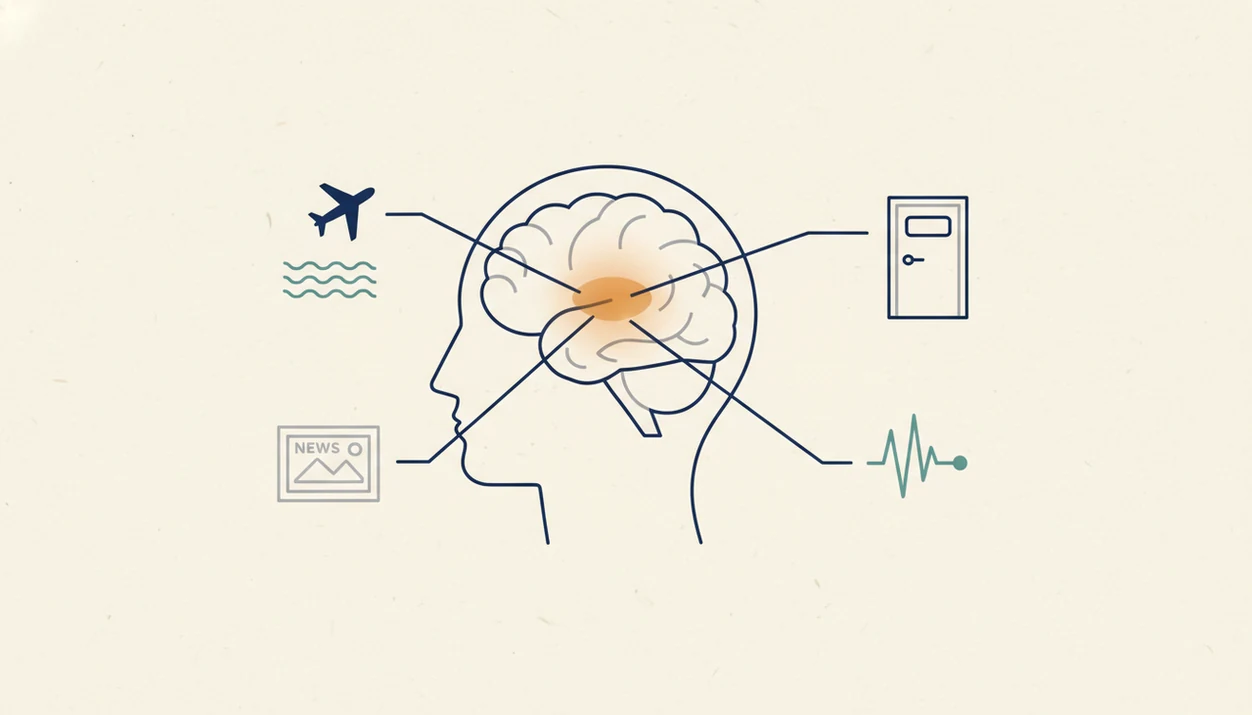
Fear of flying causes work through the brain’s threat system, especially when protective alarm circuits become over-sensitive. In plain English, your brain starts treating normal flight cues as if they are early warnings of danger.
Conditioned learning is one part of this. If turbulence, a panic attack, or a crash documentary gets paired with flying, the brain may store that link as “plane equals threat.” Later, the seat belt click can bring the whole fear file back up.
Body-sensation misinterpretation is another part. Takeoff acceleration, cabin pressure changes, adrenaline, and a brief drop feeling in the stomach can feel like proof something is wrong. Without aviation knowledge, normal movement feels abnormal.
Avoidance keeps the loop alive. When you cancel, leave the gate, or swear off flying, your body feels relief. The brain learns, “Escaping saved me.” Clinicians typically recommend gradual exposure, CBT skills, and targeted coping practice when fear is persistent or disabling.
The most common medically supported way to reduce phobic fear is gradual exposure combined with skills that change catastrophic predictions.
Five Facts About Causes Of Aviophobia
- Fear of flying rarely has one single cause; panic sensitivity, control loss, past experience, stress, and learned fear often overlap.
- A panic attack on a plane can train the brain to fear future flights, even if the aircraft was operating normally.
- Many nervous flyers fear confinement, loss of control, or panic symptoms more than an actual crash.
- Media coverage can distort risk perception because dramatic crash stories are easier to remember than routine safe flights.
- Genetics, family modeling, and general anxiety can make some people more vulnerable to aviophobia.
A good fear of flying resource should explain causes, treatments, coping strategies, and tools for nervous flyers, not just repeat safety statistics and tell you to relax.
Tools like Fear of Flying Guide can help you sort triggers into a flight-day plan, but the cause map comes first.
Panic Patterns Behind Psychological Causes Of Aviophobia
Panic patterns often explain why people fear flying when the plane itself is not the main fear. Flying can become the stage where existing anxiety finally has nowhere to hide.
Panic sensitivity on planes
Panic sensitivity means you fear the sensations of anxiety. A racing heart, warm face, tight throat, or dizzy spell can feel dangerous. On a plane, the “what if I can’t get out?” thought adds fuel. If your first panic attack happened after the phone switched to airplane mode, your brain may now treat that small action as a warning.
The related pattern is covered in more detail under anxiety sensitivity flying.
General anxiety attaching to flying
Generalized anxiety can attach to flights because airports provide endless uncertainty. Weather. Delays. Gate changes. A half-charged phone.
Health anxiety may add fears of fainting, losing control, or needing medical help mid-flight. Fear of embarrassment can be just as strong. The U.S. National Comorbidity Survey Replication found that about 28.8% of people meet criteria for an anxiety disorder at some point in life, so this overlap is not rare (https://www.hcp.med.harvard.edu/ncs/index.php).
Aircraft Cabin Triggers That Explain Why People Fear Flying
Why do people fear flying when commercial flights are routine? Many people fear the sensations and constraints of the aircraft cabin, especially when they do not know what those cues mean.
Turbulence and aircraft sensations
Turbulence, takeoff, landing, engine sounds, banking turns, seatbelt signs, and cabin announcements can all trigger the alarm system. A drink rippling on the tray table may look like evidence of danger, even when the aircraft is built for movement.
Normal flight sensations can feel abnormal without context. Engines change pitch. The plane banks. The climb angle shifts. Your body notices all of it.
Claustrophobia and loss of control
Claustrophobia is the fear of being trapped or unable to leave. Once the aircraft doors close, that fear can spike fast.
Loss of control is slightly different. Passengers cannot steer, stop, inspect, or choose the route. Height fear and fear of open space can contribute, but they are not universal causes. Many nervous flyers avoid the window and still fear panic more than altitude.
Past Flights, Media Stories, And Learned Fear Of Flying
Past flights and media stories can teach the brain to treat flying as dangerous, even when the actual risk remains low. One severe turbulence event, diversion, emergency landing, or panic episode can become a memory trigger.
Conditioning after a bad flight
Conditioning happens when the brain links a cue with fear. If you felt trapped during a rough descent, later flights may reactivate that memory before anything happens. You might be standing in the jet bridge, fine one second, then suddenly certain you cannot board.
Learned fear can also come from other people. An anxious parent, partner, or travel companion may model danger without meaning to.
Crash stories and risk perception
Availability bias means the brain treats vivid stories as more common than they are. Movies, crash documentaries, and breaking news make rare events easy to picture.
Objective safety context matters here. The U.S. National Transportation Safety Board reported zero fatalities in 2022 for domestic scheduled U.S. passenger airline flights (https://www.ntsb.gov/safety/data/Pages/Part121AccidentSurvivability.aspx). IATA reported a 2022 jet accident rate of 1.21 accidents per million flights (https://www.iata.org/en/pressroom/2023-releases/2023-03-07-01/).
For many nervous flyers, aviation education helps most when paired with body-based coping, not used as endless reassurance.
Adult Panic Triggers Behind Sudden Fear Of Flying Causes
Why am I suddenly scared to fly? Sudden fear of flying can appear after chronic stress, burnout, parenthood, grief, health scares, hormonal changes, or a major life transition, even after years of normal travel.
The first trigger may not be aviation at all. It may be a panic attack in a supermarket, a health scare at night, or months of poor sleep before a 6:40 a.m. flight. Then flying becomes the place where your body expects the next alarm.
No single cause is guaranteed. Sudden onset can also be linked with PTSD, panic disorder, claustrophobia, or another treatable condition. If the fear feels new and intense, fear of flying suddenly can help you separate stress timing from flight-specific triggers.
For adults with new flight anxiety, mapping the first panic episode is often more useful than searching for a dramatic flight memory.
5 Fear Of Flying Myths About Safety And Courage
These myths keep nervous flyers ashamed, which makes the fear harder to work with.
Myth 1: Fear of flying always comes from a previous bad flight. Many people develop it through stress, panic, family modeling, or media exposure.
Myth 2: Being afraid proves flying is unsafe. Anxiety is a danger signal, not a risk calculator.
Myth 3: You cannot suddenly develop fear later in life. Adult-onset fear is common after health worries, loss, parenthood, or burnout.
Myth 4: Fear of flying is only fear of heights. Some people fear altitude, but many fear confinement, panic, or control loss.
Myth 5: Brave people do not feel flight anxiety. Courage is boarding with a plan, not feeling nothing.
Tiny distinction. Big relief.
Cause Checklist For Fear Of Flying Triggers That Apply Or Do Not Apply
Use this checklist to match likely causes without turning it into a self-diagnosis. Turbulence fear, claustrophobia, panic fear, trauma, and control loss can overlap on the same flight.
| Possible cause | It may apply when | It may not be the main cause when |
|---|---|---|
| Turbulence fear | Fear began after rough air or sudden drops | You mostly fear panic symptoms during smooth flight |
| Claustrophobia | Door closure or boarding creates panic | You relax once seated and mainly fear takeoff |
| Panic fear | A past panic attack made flying feel unsafe | You fear specific aircraft sounds or movements |
| Trauma memory | A diversion, emergency, or frightening event replays | No clear memory trigger appears |
| Control loss | You need to check routes, weather, or pilots | The deeper fear is embarrassment or fainting |
To use the cause map: 1. Name your top two triggers before you open the airline app. 2. Write one if-then script in the Notes app. 3. Choose one small job for your body, such as feet flat on the floor. 4. Set a two-minute timer when symptoms rise. 5. Review what actually happened after landing.
Professional assessment is wise when fear is severe, trauma-linked, or causing major avoidance. FearOfFlying.com resources can sit beside therapy, courses, SOAR, or Fearless Flyer when you need worksheets between flights.
For repeated checking loops, reassurance seeking flight anxiety explains why more certainty often brings less calm.
When To Get Professional Help For Fear Of Flying
Get professional help for fear of flying when avoidance is shrinking your life, not just making one trip unpleasant. If you are missing work, skipping family events, delaying medical care, or feeling unable to take necessary travel, the fear deserves more than another checklist.
A qualified clinician can assess whether the flight fear is part of panic disorder, PTSD, claustrophobia, health anxiety, or another treatable pattern. Severe symptoms do not mean you are stuck. Many people improve with CBT, gradual exposure, or clinician-guided care that practices the feared cues in a safer, structured way.
A simple next step sequence:
- Track what you avoid, cancel, or endure with intense distress.
- Tell a primary care clinician or mental health professional what happens before, during, and after flights.
- Ask about CBT, exposure-based treatment, trauma-focused care, or panic-focused treatment if those patterns fit.
- Avoid mixing alcohol, sedatives, sleep aids, or prescriptions unless a licensed medical professional has said it is safe for you.
- Use checklists as education, not as a diagnosis.
Limitations
Identifying fear of flying causes is useful, but it has limits. The clean answer people want is often not the honest answer.
- Pinpointing one root cause is often impossible because anxiety, memory, stress, and avoidance interact over time.
- Self-diagnosing can miss panic disorder, PTSD, claustrophobia, health anxiety, or another treatable condition.
- Aviation safety education helps some people, but it can increase anxiety in people who obsess over mechanical details.
- Not all treatment evidence is specific to aviophobia because many studies group specific phobias together.
- Coping tools may work less well during grief, burnout, illness, poor sleep, or heavy work stress.
- Relapse can happen after major life events or long gaps between flights.
- Medication questions need a licensed clinician, especially if alcohol, pregnancy, medical conditions, or other prescriptions are involved.
If symptoms are severe, disabling, or trauma-linked, get professional help rather than relying only on checklists.
FAQ
What causes fear of flying?
Fear of flying is usually caused by overlapping factors such as panic sensitivity, loss of control, claustrophobia, turbulence memories, trauma, media exposure, learned fear, and life stress. There is rarely one single cause.
Why am I suddenly scared to fly?
Sudden fear of flying can appear after stress, burnout, parenthood, grief, health worries, hormonal changes, or a first panic attack. It can also be related to PTSD, panic disorder, or another treatable condition.
Can turbulence cause flight anxiety?
Yes, turbulence can condition flight anxiety if the brain links the movement with danger or panic. Turbulence is usually a normal flight sensation, but it can feel threatening without context.
Is fear of flying genetic?
Fear of flying itself is not usually inherited as one specific fear. Genetic vulnerability to anxiety can make some people more likely to develop aviophobia after stress, modeling, or frightening experiences.
Can panic attacks cause aviophobia?
Yes, a panic attack on or before a flight can become the main driver of aviophobia. The person may start fearing panic symptoms more than the aircraft.
Does claustrophobia cause fear of flying?
Claustrophobia can cause or worsen fear of flying because the passenger cannot leave once the aircraft doors close. The fear often centers on confinement, not crashing.
Can news stories cause flight fear?
Yes, news stories, movies, and crash documentaries can create or worsen flight fear through availability bias. Vivid rare events can feel more likely than routine safe flights.
Is fear of flying rational?
Fear of flying is understandable because the sensations and lack of control can feel intense. It is not usually aligned with the objective risk of commercial aviation.
Can fear of flying go away?
Fear of flying can improve through education, gradual exposure, CBT skills, coping tools, or therapy. Severe or disabling symptoms should be discussed with a qualified mental health professional.