
Panic Attack On Plane: What To Do In The Next 90 Seconds
If you are having a panic attack on plane, keep your seat belt fastened, slow your exhale, ground your attention in the cabin, and tell a flight attendant if symptoms feel new, severe, or unusual. Panic usually peaks within minutes, but red-flag symptoms such as crushing chest pain, confusion, fainting, or one-sided weakness should be treated as a possible medical emergency.
Definition: A panic attack on a plane is a sudden surge of intense fear during flight, with body symptoms such as racing heart, shortness of breath, dizziness, shaking, chest tightness, or a feeling of doom even when the aircraft is operating normally.
TL;DR
- For the next 90 seconds, lengthen your exhale, press your feet into the floor, name what you can see, and loosen one muscle group at a time.
- Common panic symptoms can feel dramatic, but new crushing chest pain, confusion, fainting, blue lips, or one-sided weakness means you should alert the crew immediately.
- In-flight panic is treatable over time with CBT, exposure practice, fear-of-flying programs, and sometimes clinician-prescribed medication.
Panic Attack On Plane Symptoms: The 5 Facts To Know First
- A panic attack on a plane is fear plus body alarm. Your nervous system acts as if danger is immediate, even when the aircraft is flying normally.
- Common symptoms include racing heart, shortness of breath, dizziness, shaking, sweating, nausea, chest tightness, tingling, derealization, and fear of dying or losing control. The dry mouth at the gate can turn into “I need to get off” fast.
- Panic symptoms usually peak within minutes. Mayo Clinic describes panic attacks as sudden surges that typically peak within 10 minutes: https://www.mayoclinic.org/diseases-conditions/panic-attacks/symptoms-causes/syc-20376021.
- A panic wave is not evidence that the plane is unsafe. It is evidence that your threat system has misread cabin sensations, altitude, or uncertainty.
- Triggers vary. Turbulence, claustrophobia, fear of losing control, a previous rough descent, lack of escape, or no obvious trigger can all start the loop.
The first job is not to prove you’re fine. It is to make your next five minutes smaller.
How Panic On Airplane Episodes Work In The Body
Panic on airplane episodes work through the fight-or-flight response: adrenaline rises, breathing speeds up, muscles tighten, and your attention starts scanning for danger. In plain language, your body hits the alarm button before your thinking brain has checked the facts.
Aircraft cues can feed that alarm. The seat-belt sign dings, the engines change pitch, or the overhead bin latch softly rattles during light turbulence. Your brain may read those cues as “trapped” or “unsafe,” then your racing heart becomes more proof that something is wrong. That is the feedback loop.
The sensations are real. The danger prediction may be false.
Focusing only on internal symptoms can amplify panic for some people. If you keep checking your pulse, breath, throat, or stomach, the scan itself becomes fuel. For many nervous flyers, external attention works better than arguing with every sensation. For recurring panic, medically supported care usually means CBT-style skills, gradual exposure to feared sensations or situations, and, for some people, clinician-supervised medication; NIMH summarizes psychotherapy and medication options for anxiety disorders here: https://www.nimh.nih.gov/health/topics/anxiety-disorders.
How To Use A 90-Second In-Flight Panic Attack Plan
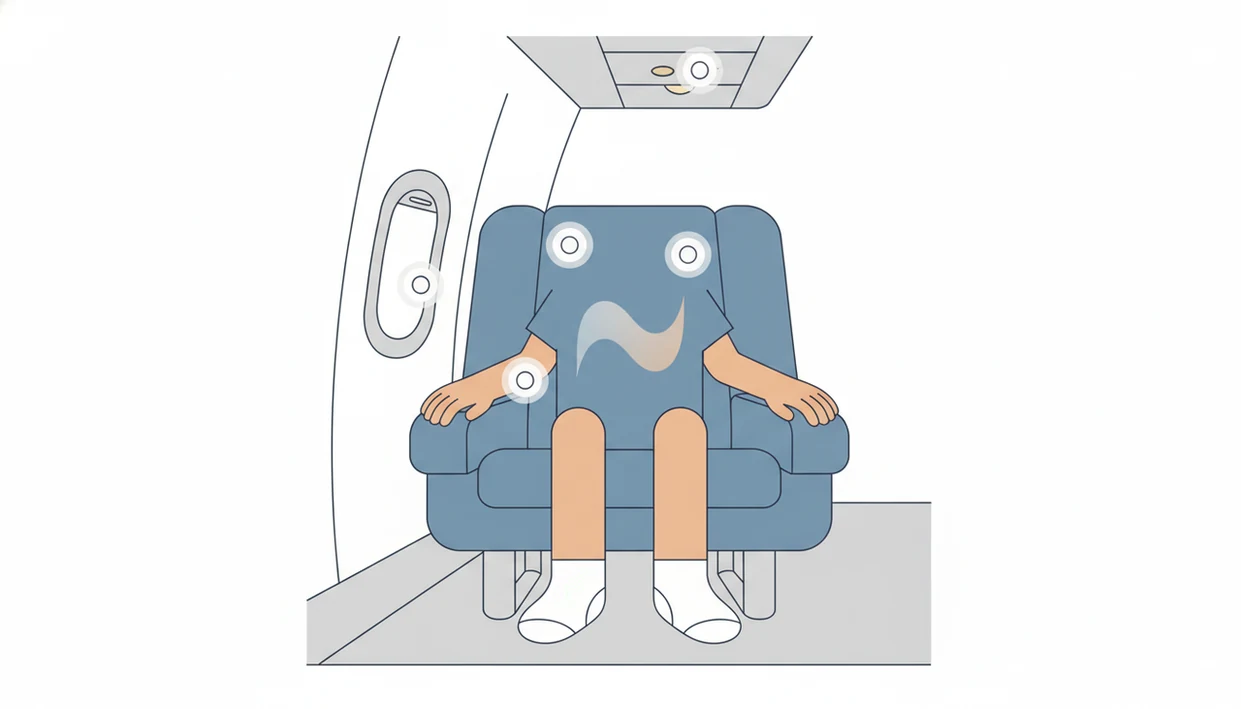
Use this plan while seated, with your seat belt fastened. Do not stand suddenly, move into the aisle, or ignore crew instructions. Make the plan boring on purpose, like a checklist in your Notes app.
- Stay seated with your seat belt low and snug, unless a crew member tells you otherwise.
- Exhale longer than you inhale: breathe in through your nose for 3, then breathe out slowly for 6.
- Press your feet into the floor and notice the exact pressure under each heel.
- Name cabin details: three colors, two straight lines, one neutral sound, and the fabric under your fingers.
- Ask for support with one sentence: “I think I am having a panic attack; can you check on me in a few minutes?”
Set a two-minute phone timer if you can reach it without frantic bag digging. Timer set for ten-minute intervals can also help after the first wave, because it gives your brain a next checkpoint instead of an endless flight.
Step 1 For Panic Attack On Plane: Make Breathing Less Threatening
Does breathing stop a panic attack on a plane? Breathing may reduce over-breathing and threat signals, but the goal is not to force calm or win a contest for the deepest breath.
Try this: inhale through your nose for 3, then exhale slowly for 6. Repeat 6 to 10 rounds. Keep your shoulders loose and your jaw unclenched. If counting makes you more tense, sigh out slowly instead, then let your shoulders drop on the next exhale.
Do not hold your breath aggressively. Do not chase a perfect deep breath. That can make you monitor your body even harder, and dizziness can increase if you overdo deep breathing.
One small job for your body: make the out-breath longer than the in-breath. That’s enough for now.
Step 2 For In Flight Panic Attack: Ground Attention Outside Your Body
Use grounding to move attention away from symptom checking and back into the cabin. External attention helps interrupt the “What is my heart doing now?” loop.
- Find three colors near your seat, such as navy fabric, silver tray latch, and white safety card.
- Trace two straight lines with your eyes, like the seat seam and the window shade edge.
- Name one neutral sound, such as the air vent, page turning, or cabin hum.
- Press both feet into the floor and compare left heel to right heel.
- Feel one texture under your fingers, like denim, armrest plastic, or the paper boarding pass.
Quiet works.
If your mind says “what if,” return to the task without debating. “What if” is not an instruction. It is a panic phrase. For more preparation before travel day, a pre-flight anxiety routine can make these steps easier to remember under pressure.
Step 3 For Panic On Airplane: Use Crew Support And Simple Scripts
Use crew support early if panic is escalating, especially if you feel embarrassed and tempted to hide it. Flight attendants have seen nervous passengers before, and a clear sentence helps them respond.
- Seatmate script: “I’m having a panic wave. I don’t need fixing, but please talk to me for two minutes.”
- Crew script: “I think I am having a panic attack; can you check on me in a few minutes?”
- Medical-uncertainty script: “These symptoms feel new for me. I’m not sure if it’s panic or medical.”
- Aftercare script: “Could I have water when it’s safe to move around?”
Crew may offer reassurance, water when appropriate, breathing prompts, or help assess whether a medical concern needs attention. Typical panic does not usually mean the plane will divert or that someone can be let off mid-flight.
No door demands. No sudden aisle sprint.
A good fear of flying help plan teaches support scripts, not dramatic escape moves.
Panic Attack On Plane Or Medical Emergency: Red-Flag Symptom Check
Common panic symptoms can feel severe, but some symptoms need immediate crew attention. Alert the crew if symptoms are new, severe, unusual, or you are unsure.
| Common panic symptoms | Red-flag symptoms to report immediately |
|---|---|
| Racing heart | New crushing chest pain |
| Trembling or shaking | Pain spreading to arm, jaw, or back |
| Sweating | Fainting or loss of consciousness |
| Tingling in fingers or face | Blue lips or severe trouble breathing |
| Shortness of breath that improves with slower breathing | Severe allergic reaction or swelling |
| Fear of dying or losing control | Confusion, seizure, or one-sided weakness |
| Dizziness that improves with grounding | Trouble speaking or symptoms after injury |
Online guidance cannot diagnose heart, lung, neurological, or allergic emergencies. For example, the American Heart Association lists chest pressure, pain spreading to the arm, jaw, back, or shortness of breath as possible heart attack warning signs: https://www.heart.org/en/health-topics/heart-attack/warning-signs-of-a-heart-attack. CDC stroke guidance also treats face drooping, arm weakness, speech trouble, confusion, and sudden neurological changes as urgent warning signs: https://www.cdc.gov/stroke/signs-symptoms/index.html. If you are gripping the armrest and thinking, “This is different from my usual panic,” say that to the crew. Clear information helps them decide whether to ask for medical help onboard.
Common Panic Attack On Plane Myths That Make Fear Worse
- Myth: “Panic means I will die or my heart will stop.” Panic feels dramatic, but typical panic symptoms are not the same as cardiac arrest.
- Myth: “Panic means I am losing my mind or I’m weak.” Panic is a nervous-system alarm, not a character flaw.
- Myth: “The plane must turn around if I panic.” Diversions are generally for true medical or safety emergencies, not typical panic alone.
- Myth: “Avoiding flying will make the fear disappear.” Avoidance often keeps the fear fresh because your brain never learns the flight can be tolerated.
- Myth: “Medication is the only real solution.” Medication can help some people, but CBT skills, exposure practice, education, and support plans also matter.
For a flight tomorrow, the most useful plan is usually practical rather than inspirational. If you need a short runway plan, how to not be scared of flying tomorrow should focus on sleep, caffeine, scripts, and in-seat coping.
Longer-Term Help For Panic Attack On Plane Patterns
Seek professional help if panic attacks repeat, you avoid flights, you feel distressed for weeks before travel, or fear starts shaping work, family, or medical decisions. Clinicians typically recommend CBT, exposure therapy, fear-of-flying courses, virtual reality exposure, and sometimes clinician-supervised medication options.
Treatment usually reduces fear over weeks to months, not in one heroic flight. NIMH estimates that about 3.7% of U.S. adults meet criteria for panic disorder in a given year (https://www.nimh.nih.gov/health/statistics/panic-disorder), and about 31.1% experience an anxiety disorder at some point in life (https://www.nimh.nih.gov/health/statistics/any-anxiety-disorder). Cleveland Clinic reports that significant fear of flying, or aerophobia, affects an estimated 2.5% to 6.5% of people, while many more report some flight anxiety: https://my.clevelandclinic.org/health/diseases/22318-aerophobia-fear-of-flying.
A useful nervous flyer guide should explain causes, treatments, coping strategies, and tools for nervous flyers, not sell one magic calming trick. Tools like Fear of Flying Guide can fit here when they stay practical, evidence-based, and focused on preparation before the airline app refresh begins. For ongoing skill building, fear of flying tips can support the treatment work between trips.
Limitations
- Breathing and grounding can reduce panic intensity, but they do not replace medical evaluation for new or severe symptoms.
- This article cannot diagnose panic disorder, aerophobia, heart disease, asthma, pulmonary embolism, stroke, or allergic reactions.
- Some people feel worse when focusing on breathing or body sensations. They may need external grounding, movement when allowed, or therapist-guided practice.
- Medication decisions should be made with a licensed clinician, especially when flying, drinking alcohol, driving after landing, or using other sedating drugs.
- Evidence specific to panic attacks on planes is more limited than general panic disorder research.
- CBT, exposure therapy, and fear-of-flying treatment can take weeks or months and may not remove all anxiety.
- Flight crew instructions and onboard medical assessment override any article advice.
FearOfFlying.com can help with education and coping structure, but it cannot replace a clinician or emergency assessment.
FAQ
Can panic attacks happen on planes?
Yes. Panic attacks can happen on planes and may be linked to confinement, turbulence, fear of losing control, a previous flight experience, or no clear trigger.
Are plane panic attacks dangerous?
Panic itself is usually not life-threatening, but symptoms can feel intense. Tell the crew immediately for crushing chest pain, fainting, blue lips, confusion, one-sided weakness, or symptoms that feel new or unusual.
How long do panic attacks last?
Panic often peaks within minutes, with Mayo Clinic describing panic attacks as typically peaking within 10 minutes. Shakiness, fatigue, or worry can last longer after the peak passes.
Should I tell a flight attendant?
Yes, tell a flight attendant if symptoms feel overwhelming, new, severe, or medically uncertain. A simple script is: “I think I’m having a panic attack; can you check on me?”
Can turbulence trigger panic attacks?
Yes. Turbulence can trigger panic by increasing threat perception, even though normal turbulence is an expected part of flying.
What helps panic while seated?
Longer exhales, feet-on-floor grounding, naming cabin details, relaxing one muscle group, and asking for support can help. Keep your seat belt fastened and follow crew instructions.
Can medication help flight panic?
Some medications may help flight panic, but they should be discussed with a clinician before travel. Ask about sedation, alcohol, driving after landing, and interactions with other drugs.
Will the plane divert for panic?
A plane usually does not divert for typical panic symptoms alone. Diversions are generally for true medical or safety emergencies.
How do I prevent flight panic?
Prevention usually involves CBT skills, exposure practice, fear-of-flying education, sleep planning, caffeine reduction, and clinician advice when symptoms are recurring or severe.