
Exposure Therapy For Fear Of Flying Without Being Forced Onto A Plane

Exposure therapy for fear of flying is a planned, gradual way to face flight-related triggers until your fear response starts to fall. It is not the same as being pushed onto a plane; structured exposure uses a ladder, repetition, and response prevention so your brain can relearn what is actually dangerous.
This guide is educational and is not a substitute for care from a licensed mental health or medical professional. If flying fear involves panic attacks, trauma, fainting concerns, substance use, or medication questions, plan exposure work with a qualified clinician.
> Definition: A flight exposure ladder is a ranked list of flying-related situations, from mildly uncomfortable to highly feared, that you practice repeatedly and intentionally before moving to harder steps.
- Aviophobia exposure therapy usually starts far away from real flying, such as photos, sounds, videos, airport visits, or virtual reality.
- The goal is not to eliminate all anxiety before flying; the goal is to learn that anxiety can rise, peak, and fall without avoidance or escape.
- A structured flight exposure ladder works best when it is repeated, tracked, and customized to the specific part of flying you fear.
Exposure Therapy For Fear Of Flying At A Glance
Exposure therapy for fear of flying means practicing flight-related cues in a planned sequence, not forcing yourself through a terrifying trip and hoping it helps. It is often part of CBT, where you pair repeated practice with new thinking, body skills, and response prevention.
That last phrase matters. Response prevention means you don’t escape, over-check, numb out, or use a ritual so heavily that your brain never learns the cue was tolerable.
An estimated 25 million U.S. adults have fear of flying, according to Cleveland Clinic source. For many nervous flyers, the first exposure is not a boarding pass. It might be a takeoff video played twice, with your phone timer set for two minutes.
Small counts.
Five Facts About Aviophobia Exposure Therapy
- Exposure is planned contact with feared flying cues. It is not a surprise confrontation, a dare, or being cornered into boarding.
- A flight exposure ladder ranks triggers from easiest to hardest. Photos may sit near the bottom; turbulence, takeoff, or being far from home may sit higher.
- Repeated practice teaches the nervous system that fear can fall without escape. The lesson is, “I felt panic, stayed present, and nothing catastrophic happened.”
- Virtual reality exposure therapy has evidence for real-world behavior change. In one program, average flights per month and flight hours increased after treatment.
- Sedatives may reduce anxiety short term, but they do not retrain the phobia pattern on their own. Medication questions belong with a qualified clinician, especially if alcohol, panic attacks, or other prescriptions are involved.
Clinicians typically recommend exposure-based CBT for specific phobias because it targets both avoidance and danger predictions.
How Exposure Therapy For Fear Of Flying Works
Exposure therapy works by changing fear learning: your brain predicts danger, you avoid the cue, and avoidance teaches the brain to keep warning you next time. Inhibitory learning is the newer term often used here. Plainly, it means your brain learns a competing message: “This feels threatening, but I can stay and update the prediction.” The American Psychological Association describes exposure therapy as a treatment that helps people safely face feared objects, activities, or situations so fear can decrease over time source.
Anxiety does not have to vanish for an exposure step to count. If your distress drops from an 8 to a 6, or if you stop leaving the video after 20 seconds, learning has started.
Response prevention keeps the lesson clean. That means not escaping, not texting five people for reassurance, not checking turbulence maps every minute, and not using alcohol as the main coping tool. A good comprehensive fear of flying resource should explain causes, treatments, coping strategies, and tools for nervous flyers, not just say “planes are safe” and leave you alone at the gate.
Before You Start A Flight Exposure Ladder
Before you start a flight exposure ladder, define the fear you are actually practicing with and decide how you will measure progress. A safer ladder has a target, a tracking method, and a clear plan for when to pause or get help.
- Name your main fear pattern. Notice whether the spike is mostly panic sensations, turbulence, crashes, being trapped, heights, germs, separation from home, or not being in control. Your ladder should match that pattern.
- Choose your rating system. Use one 0 to 10 distress scale every time, then record the start, peak, and finish in a notebook, spreadsheet, or phone note.
- Pick safety behaviors to reduce. Decide which rituals you will gently cut back, such as constant weather checks, reassurance texts, alcohol, aisle-only rules, or gripping the armrest the whole time.
- Set a stop rule. Pause exposure if distress feels unmanageable, you feel medically unsafe, or symptoms become confusing rather than just uncomfortable.
- Involve a therapist early. Get professional support if panic attacks, trauma memories, fainting fears, substance use, severe avoidance, or medication questions are part of the picture.
How To Use A Flight Exposure Ladder Safely
To use a flight exposure ladder safely, start with one target and move in measured steps. The plan should feel boring on purpose, not dramatic.
Use the same distress scale every time, and write down what you did instead of relying on memory. If a step repeatedly reaches a 9 or 10 out of 10, split it into smaller steps rather than pushing harder.
- Set a target outcome. Choose something specific, such as tolerating takeoff videos, visiting an airport, or booking a short flight.
- List your flight triggers. Include sounds, airport queues, boarding, turbulence, takeoff, enclosed space, and being far from home.
- Rank each item by distress. Use a 0 to 10 scale before you open the airline app or start searching flights.
- Practice one step repeatedly. Stay long enough for your body to learn that anxiety can rise, peak, and fall.
- Move upward only after learning. Do not advance because a partner, boss, or calendar is pressuring you.
Tools like Fear of Flying Guide can help you organize education and practice, but the ladder itself should match your actual fear pattern. For a therapy-based overview, start with CBT for fear of flying.
Sample Flight Exposure Ladder From Photos To Real Flights
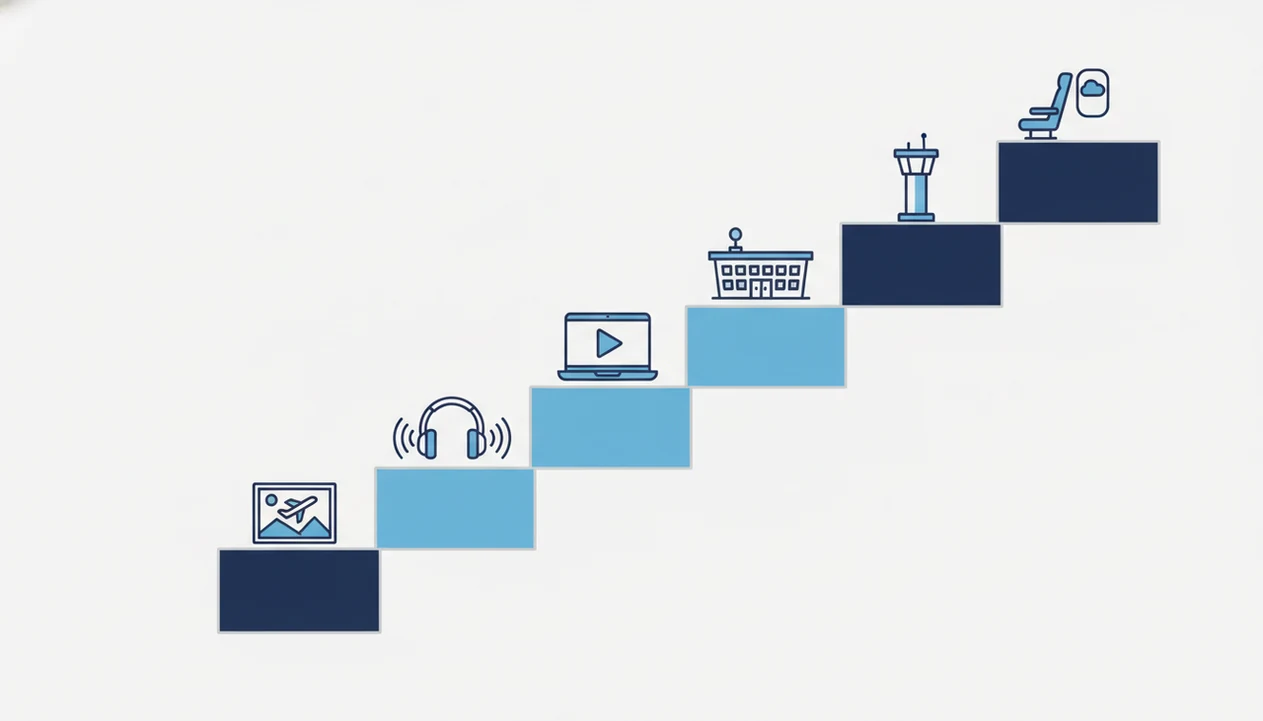
A sample flight exposure ladder should begin below your panic line and end near your real travel goal. Adjust the order if your main fear is turbulence, loss of control, heights, crashes, panic symptoms, or enclosed spaces.
- Low-intensity steps: Read plain flight safety facts, look at plane photos, listen to cabin announcements, or play engine sounds for one minute.
- Moderate steps: Watch takeoff videos, pack a small carry-on, stand in an airport terminal, or use flight simulators and VR.
- Higher steps: Sit on a stationary aircraft, complete a short flight, then later try longer flights.
- Custom steps: If turbulence is the trigger, practice videos where the drink ripples on the tray table and label what the aircraft is doing.
Virtual practice is covered in more detail in virtual reality exposure therapy flying.
Exposure Therapy Versus White-Knuckling A Forced Flight
White-knuckling a forced flight can reinforce fear if the only lesson is, “I survived because I escaped mentally, drank, took a sedative, or gripped the armrest for two hours.” Exposure needs the feared outcome to be noticed, tested, and processed.
| Approach | What happens | Likely learning |
|---|---|---|
| Planned exposure | You practice a ranked step repeatedly | “Fear rose, then became manageable.” |
| Flooding | You face the hardest trigger all at once | Sometimes useful clinically, but often too intense without consent and support |
| Avoidance | You cancel, delay, or delegate travel | “Flying must be dangerous because I escaped.” |
| Ordinary travel pressure | You fly because you must | Learning depends on whether you notice safety, reduce rituals, and repeat practice |
Exposure-based CBT is a first-line, well-supported treatment approach for specific phobias because it targets both avoidance and feared predictions source.
Common Myths About Aviophobia Exposure Therapy
The first myth is that a therapist will make you board a plane immediately. Good exposure work is collaborative; you should know the step before you practice it.
The second myth is that one terrifying flight equals therapy. It doesn’t. If you spend the whole trip with knees braced against the seat pocket and no review afterward, the fear story may stay intact.
Another myth is that VR is too fake to help. Research suggests VR can still trigger enough flight cues for learning, especially before real airport practice.
Exposure is not just willpower. It uses prediction testing, repetition, and response prevention. You also do not need to be calm for it to work. The job is not “feel nothing.” The job is “stay long enough to learn.”
For evidence questions, the page on does CBT for fear of flying work goes deeper.
Between-Session Practice For Fear Of Flying Exposure
Between-session practice turns exposure from an appointment into a new habit loop. Track distress before, during, and after each step. Use three numbers: start, peak, finish.
Write the feared prediction too. “If I watch this takeoff video, I’ll panic and lose control.” Then write what actually happened. That record matters when your brain tries to rewrite history at midnight before a 6:40 a.m. flight.
Keep practices short and repeatable. A two-minute phone timer with cabin sounds is often more useful than waiting six months for one major flight. Use coping skills, but don’t turn them into escape rituals. A breathing count in your Notes app is fine; refusing to continue unless you feel totally calm can block learning.
If panic, trauma, fainting fears, severe depression, substance use, or medical concerns are present, plan homework with a therapist.
Common Mistakes When Practicing Flight Exposure
The most common mistakes in flight exposure are going too hard, escaping too soon, or hiding avoidance inside “coping.” Good practice should stretch you, not prove that flying fear can overwhelm you.
- Start below your panic line. Choose a step that raises discomfort but still lets you stay present. Jumping straight to turbulence videos, airport security, or a long-haul flight can make the ladder feel unsafe before learning has a chance to happen.
- Watch for disguised avoidance. Alcohol, repeated reassurance, constant flight tracking, and endless weather checks may feel practical, but they can teach your brain that you survived only because of the ritual.
- Stay through the rise. Do not end every practice the second anxiety climbs. When possible, remain long enough to notice a peak, a plateau, or even a small drop.
- Advance because of learning. Move up when the step is more familiar and your predictions are changing, not because someone else is impatient.
- Record the practice. Write down the trigger, prediction, start, peak, finish, and what you learned. Without notes, progress is easy to miss.
Signs Your Flight Exposure Ladder Is Working
“How do I know exposure therapy for fear of flying is working?” Look for behavior change, not instant comfort.
Your anxiety may peak and fall faster during repeated practices. You may watch a takeoff video without closing the tab, enter an airport without leaving immediately, or book a short flight before asking everyone for reassurance. Predictions also become more realistic. “The plane will drop from the sky” may shift into, “Turbulence feels awful, but aircraft are built for it.”
You may rely less on checking, alcohol, sedatives, escape plans, or repeated texts that say, “I can’t do this.” In a 2021 virtual reality exposure therapy program, average flights per month increased from 0.04 to 0.16, and flight hours rose from 0.19 to 0.79 after treatment source.
Progress can look quiet. A boarding pass in Apple Wallet, left alone.
Limitations
Exposure therapy has real limits, and ignoring them makes the plan less safe.
- It is not a quick fix. Many people need multiple sessions, homework, and repeated practice.
- Some flyers need treatment for panic disorder, PTSD, severe depression, substance use, or medical problems alongside flight exposure.
- Virtual reality exposure is not available everywhere, and it may not feel realistic enough for every client.
- Medication may still be appropriate for some people, but decisions should be made with a qualified clinician. The flight anxiety medication guide lists questions to ask.
- Poorly planned exposure can backfire if it becomes overwhelming, coercive, or dependent on safety rituals.
- Real flights involve money, schedules, family pressure, work demands, airline delays, and seat assignments therapy cannot fully control.
- Self-guided ladders are easier when fear is mild. Severe avoidance usually deserves professional support.
Fear of Flying Guide and FearOfFlying.com can be useful starting points, but they do not replace clinical care when symptoms are complex.
FAQ
Does exposure therapy work for flying?
Yes. Exposure-based treatment is among the best-supported approaches for specific phobias, including fear of flying.
Is exposure therapy forced flying?
No. Structured exposure is collaborative and gradual, and it usually starts well before any real flight.
What is a flight exposure ladder?
A flight exposure ladder is a ranked list of flying triggers, from easier steps like photos or sounds to harder steps like takeoff, turbulence, or real flights.
Can VR help fear of flying?
Yes. Virtual reality exposure can help some people practice flight cues before real airport or airplane practice.
How long does exposure therapy take?
Timing varies by severity, avoidance history, other anxiety conditions, and how consistently homework is practiced.
Can I do exposure alone?
Self-guided practice may be reasonable for mild fear, but panic, trauma, medical concerns, or severe avoidance are safer with a therapist.
Should I take medication first?
Medication decisions should be made with a medical clinician. Sedatives alone may reduce short-term anxiety but usually do not retrain the phobia pattern.
What if exposure makes panic worse?
Distress can rise during exposure, but overwhelming or unsafe practice should be slowed down and adjusted with professional help.
Do I need to fly eventually?
Many people use real flights as the final goal, but early exposure steps can begin without boarding a plane.