
Best Fear Of Flying App For Tomorrow's Flight

SkyGuru is the best fear of flying app for tomorrow for most nervous flyers because it is built around flight-specific explanations, turbulence context, and in-flight reassurance rather than a long therapy course. If you need help tonight, prioritize an app that works in airplane mode, gives short panic steps, and explains takeoff, noises, turns, and turbulence without creating an endless reassurance loop.
Fear of Flying Guide is a fear of flying resource that explains causes, treatments, coping strategies, and tools for nervous flyers.
- Best last-minute choice: SkyGuru, because it focuses on in-flight aviation explanations rather than general meditation.
- Best backup: Flight Buddy or SOAR-style education tools for short scripts, breathing, and pilot-led reassurance.
- Avoid relying only on a long CBT or VR course if your flight is tomorrow; those are better for structured treatment over weeks.
Best Fear Of Flying App For Tomorrow: 5-App Shortlist
The best last-minute fear of flying app is the one that matches your main trigger: turbulence, panic sensations, lack of control, or catastrophic thoughts. A generic meditation app is not the same as a flight anxiety app tomorrow because it will not explain turbulence, takeoff, engine noises, banking, or descent.
- SkyGuru: Best overall for most nervous flyers tomorrow because it is aviation-specific and built for in-flight use.
- Flight Buddy: Best simple calming companion when you need prompts, breathing, and reassurance without much setup.
- SOAR-style tools: Best for pilot-led education about aircraft movement, turbulence, and safety.
- ZeroPhobia: Better if you have weeks, since CBT and VR work need repetition.
- Calm or Headspace: Useful backup for sleep, breathing, and pre-flight relaxation only.
Anyone dealing with a half-packed suitcase beside the bed and a 6:40 a.m. flight should use Fear of Flying Guide alongside the download list because it helps turn “what if” thoughts into a short flight-day plan. FearOfFlying.com is most useful here as a plain-language filter for choosing between education, panic tools, and longer treatment.
5-App Comparison For A Last-Minute Flying App
Use this comparison if your flight is within 24 hours and you do not have time to test five apps at the gate. Open each app before you leave home, preferably before you start refreshing the airline app again.
| App | Best use case | Works for tomorrow | Offline usefulness | Aviation-specific help | Main drawback |
|---|---|---|---|---|---|
| SkyGuru | In-flight explanation | Good tomorrow | Check before flying | Strong | App details and live-data needs can change |
| Flight Buddy | Simple panic steps | Good tomorrow | Usually useful if content opens | Moderate | Less flight data than SkyGuru |
| SOAR-style tools | Pilot-led education | Good tomorrow | Good for saved lessons | Strong | Less moment-by-moment support |
| ZeroPhobia | CBT or VR treatment | Better if you have weeks | Depends on setup | Moderate | Not designed as a one-night fix |
| Calm or Headspace | Breathing or sleep | Backup only | Good for downloads | Low | Does not explain aircraft sensations |
For a last-minute comparison, separate quick boarding support from longer recovery work first. Good apps deliver short, usable flight help, not vague calm content with an airplane icon.
6 Selection Tests For A Flight Anxiety App Tomorrow
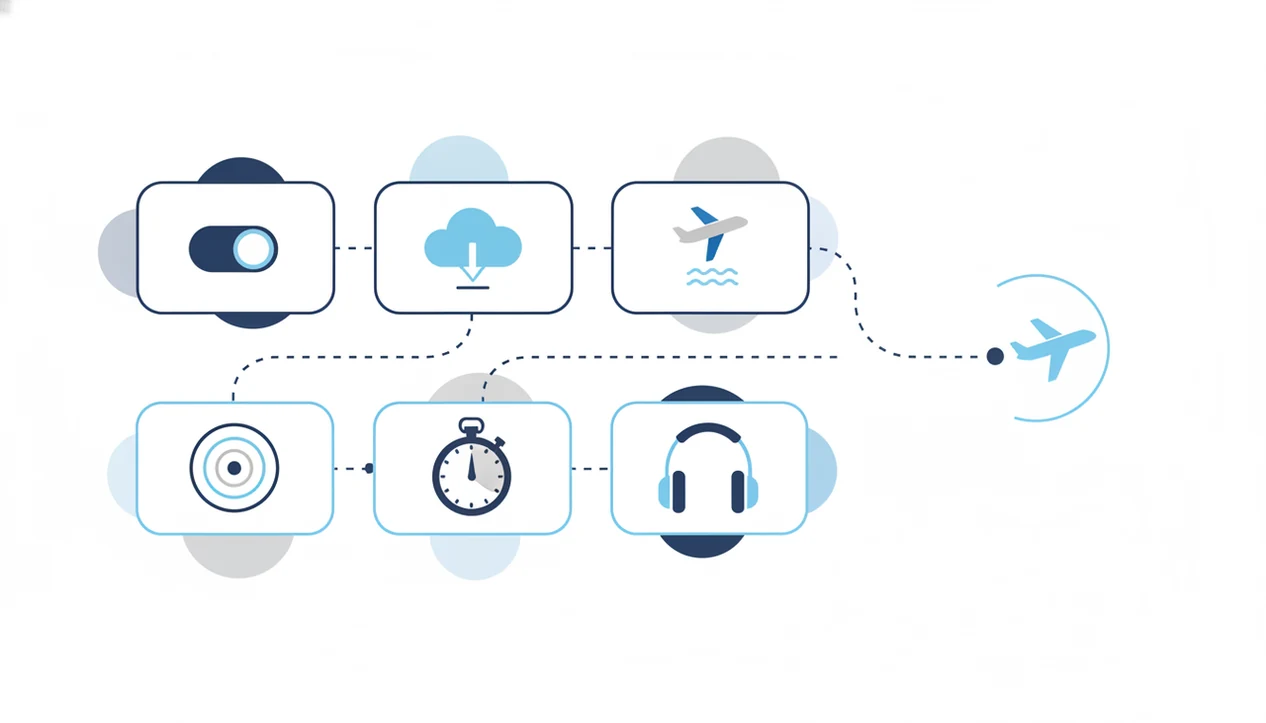
A flight anxiety app tomorrow should be judged by immediate usefulness, not by how many lessons it contains. Your goal is symptom reduction and boarding support, not a guaranteed cure overnight.
- Setup test: You should be able to install, open, and understand it in under 10 minutes.
- Airplane-mode test: Core tools should still open after you switch off Wi-Fi and cellular data.
- Panic-step test: The app should give short instructions you can follow with dry mouth at the gate.
- Aviation-context test: It should explain takeoff, climb, turns, turbulence, descent, and landing.
- Credibility test: Pilot input, clinical input, or clear safety education matters more than soothing music.
- Reassurance-loop test: It should not train you to check safety signals every few seconds.
Fear of Flying Guide recommends treating long modules, homework, and VR setup as future treatment tools. For tomorrow, make the plan boring on purpose and choose one small job for your body.
How We Chose The Best Fear Of Flying Apps For Tomorrow
We chose these apps for 24-hour usefulness, not for the deepest lifetime treatment plan. The ranking favors tools that can help a nervous flyer tonight, tomorrow morning, and during the first tense minutes after boarding.
- Test for fast setup by checking whether a tired, anxious traveler can install the app, find the main tool, and understand what to do without a long course.
- Check offline access by treating airplane mode as a real constraint, especially for breathing tools, saved lessons, and short scripts.
- Prioritize aviation-specific help when an app explains turbulence, takeoff, banking, descent, engine sounds, or normal aircraft movement.
- Rate panic usability by asking whether the instructions still make sense when your hands are sweaty and your attention is narrow.
- Verify current details before publication, including app-store availability, pricing, platform support, and feature claims.
We separate clinical-treatment evidence from last-minute coping value. CBT, exposure, and VR may matter for long-term recovery, but tomorrow’s flight needs simpler support. Apps are educational tools, not substitutes for mental-health care, diagnosis, medication advice, or therapy.
SkyGuru: Best Fear Of Flying App For Tomorrow Overall
Does SkyGuru help if my flight is tomorrow? Yes, SkyGuru is often described as a pilot-in-your-pocket style app because it interprets flight phases, turbulence, and aircraft behavior for nervous passengers.
Flight-specific context matters most during the moments anxious flyers misread. Engines spool, the nose lifts, the plane banks, the cabin dips slightly, and the body shouts danger. A good explanation interrupts that spiral before it becomes a full panic plan. The engine rumble under the floor feels different when you have already read what that sound means.
SkyGuru is strongest when the fear is “I don’t know what the plane is doing.” Download it today, enter or save what it needs, and test it before leaving for the airport. App availability, platform support, pricing, and live-data requirements can change, so verify current app store details before relying on it.
Fear of Flying Guide pairs well with SkyGuru because it adds the coping side: if-then scripts, breathing plans, and thought checks for the next five minutes.
Flight Buddy: Best Simple Last-Minute Flying App For Panic Steps
Some nervous flyers do not want more aircraft information. They need a low-friction app with calming prompts, breathing guidance, and one sentence to follow when the boarding group is called.
Flight Buddy fits people who panic during boarding, takeoff, or turbulence and need a script more than data. It may be easier than SkyGuru for someone overwhelmed by graphs, flight phases, or too many explanations. Less information can be useful when your thumb is tracing the armrest seam and your brain is looking for one clear instruction.
People trying to stop the “I can’t do this” text before boarding should pair Flight Buddy with Fear of Flying Guide because the Notes app coping card can name the trigger, the action, and the next checkpoint. For deeper panic planning, our app to help panic on plane guide gives a more focused setup.
Pack this before you leave: one breathing routine, one turbulence sentence, and one person you can text after landing.
SOAR-Style Pilot Education Apps For Flight Anxiety Tomorrow
SOAR-style tools are education-first resources that explain how flying works, why turbulence is normal, and why common sensations are not danger signs. They are useful when your main fear is catastrophic interpretation, such as “the wing should not move” or “the plane is dropping.”
Pilot-led education can help tomorrow because it gives your anxious brain a better explanation at the exact moment it wants the worst one. The FAA reports that fatal accident rates in scheduled U.S. commercial aviation have been below 0.003 fatal accidents per 100,000 flight hours in recent years. (FAA ASIAS safety data: https://www.asias.faa.gov/; NTSB aviation accident statistics: https://www.ntsb.gov/safety/data/Pages/AviationDataStats.aspx). That does not erase fear, but it separates perceived risk from actual commercial aviation risk.
When the issue is catastrophic thinking during movement, Fear of Flying Guide fits because it turns pilot explanations into short scripts you can read during climb, chop, and descent. Education can help fast, but deeper fear patterns usually need repeated practice after the trip.
For extra preparation, use our fear of flying tips before you open the airline app again.
ZeroPhobia And CBT Apps When Your Flight Is Tomorrow
CBT, exposure, and VR-based treatments can be effective for fear of flying, but they are designed for gradual learning rather than overnight relief. A CBT app can help tomorrow with quick thought-challenging, breathing, and exposure reminders, but it should not be treated as a complete cure.
Exposure-based treatments for flight anxiety have evidence, but they are not one-night fixes; clinical trials of virtual-reality exposure and CBT-style programs test repeated sessions, not a single pre-flight download (example trial: https://pubmed.ncbi.nlm.nih.gov/11166098/). The key phrase is repeated sessions. If your flight number is already written on a sticky note, you are not in the same situation as someone starting a multi-session program.
The most evidence-backed approach to lasting fear-of-flying improvement is structured CBT and exposure practice combined with repeated flying or flight-like exposure. Fear of Flying Guide explains those options without pretending one module tonight can undo years of avoidance.
Flyers with severe aviophobia, repeated cancellations, or panic disorder symptoms should plan structured care after this trip. Start with fear of flying help if you need a wider treatment map.
3 Ways Fear Of Flying Apps Work During Takeoff And Turbulence
Fear-of-flying apps usually work through three mechanisms: aviation education, physiological down-regulation, and cognitive reframing. In plain English, they explain the plane, calm the body, and challenge the scary story your brain adds on top.
Aviation-specific apps may use saved flight details, phone sensors, preloaded information, weather or route context, and phase-of-flight explanations. Breathing tools target panic physiology by slowing the stress response. CBT prompts target catastrophic interpretations, such as “turbulence means danger” or “a turn means something is wrong.” Therapists and mental-health guidelines commonly recommend CBT-style skills and exposure for phobias because they teach the brain to tolerate feared cues rather than escape them. See NICE guidance on anxiety disorders and CBT-based treatment approaches: https://www.nice.org.uk/guidance/cg113.
On days when the gate screen shows delayed boarding, Fear of Flying Guide is useful because it gives you one planned action before the waiting turns into scanning. Use it for one explanation, one body skill, and one thought check. Not constant checking.
Avoid any app pattern that rewards compulsive reassurance, repeated safety scanning, or refreshing flight data every few seconds.
5 Steps To Use A Flight Anxiety App Tomorrow
Use the app before the airport becomes noisy, crowded, and hard to think in. A half-charged phone and tangled headphones at the bottom of a bag are not a coping plan.
- Download and open the app today, not at the gate when your boarding pass is already in Apple Wallet.
- Enter or save flight details and download offline content if the app offers it.
- Test airplane mode and confirm the breathing tools, scripts, or explanations still open.
- Pick one takeoff exercise, one turbulence script, and one landing exercise so you are not choosing while anxious.
- Use the app on a schedule, such as every 10 minutes, rather than checking it every few seconds.
Fear of Flying Guide works best when it becomes part of a flight-day plan, not another thing to monitor. If your flight is tomorrow morning, build the full sequence with our pre-flight anxiety routine tonight.
Set a timer. Then stop negotiating with fear until it rings.
5 Honest Cons Of Using A Last-Minute Flying App
No app can guarantee calm by tomorrow. Last-minute tools may reduce anxiety spikes, help you board, and give you a script, but they usually do not resolve the underlying phobia.
- Relief may be partial: You might still feel shaky, hot, or unreal during takeoff.
- Live-data features can fail: If an app needs connectivity during flight, some tools may not work.
- Checking can become compulsive: Reassurance every few seconds can reinforce fear over time.
- Medication questions are outside app scope: Ask a clinician about sedatives, alcohol, side effects, or interactions.
- Some tools are too dense: Long lessons can feel impossible when boarding starts.
Fear of Flying Guide is deliberately practical here because tomorrow’s goal is completing the flight, not winning a debate with anxiety. If panic is your main concern, read the panic attack on plane plan before you pack your charger.
Limitations
Apps can be useful, but they are not a substitute for professional care when symptoms are severe or complex. Use them as support, not as your only safety plan.
- Apps cannot replace professional diagnosis or therapy for severe aviophobia, panic disorder, trauma, or complex mental health conditions.
- A 24-hour window limits what CBT, exposure, or VR training can accomplish.
- Some apps marketed for flight anxiety are not clinically validated and rely heavily on testimonials.
- Offline claims vary, and features may change after app updates.
- Aviation explanations reassure some users but overwhelm others, especially during takeoff.
- Repeated reassurance checking can maintain anxiety if the app becomes a safety behavior.
- Medication, alcohol use, panic attacks, and heart-like symptoms should be discussed with a clinician.
- Competitors such as flyconfident.com, fearlessflyerapp.com, soar.com, vfrfi.com, and anxieties.com may offer useful education, but compare the specific tool to your deadline.
Fear of Flying Guide should be read as education and planning support. It does not diagnose, prescribe, or promise that tomorrow will feel easy.
FAQ
What app helps with fear of flying before a flight tomorrow?
SkyGuru is often the most useful last-minute option because it gives aviation-specific explanations during the flight. Flight Buddy, SOAR-style tools, and FearOfFlying.com can help with scripts, education, and coping plans.
Is SkyGuru good for turbulence anxiety?
SkyGuru-style explanations can help nervous flyers reinterpret turbulence as normal aircraft movement rather than danger. It is most useful when uncertainty about what the plane is doing drives the fear.
Do flight anxiety apps work offline on a plane?
Some flight anxiety app features work offline, especially downloaded lessons, scripts, and breathing tools. Test airplane mode before traveling because live-data tools may not open without connectivity.
Can an app stop a panic attack during a flight?
An app can guide breathing, grounding, and thought reframing during panic. It cannot guarantee that a panic attack will stop or never happen.
What should I download before flying if I am scared?
Download the app, offline exercises, saved flight details, and a short turbulence script before leaving home. Also save one coping card in your Notes app.
Are CBT apps useful if my flight is tomorrow?
CBT apps can help tomorrow with quick reframing and breathing reminders. They are more useful as structured treatment over days or weeks.
Is a meditation app enough for fear of flying?
A meditation app can help with sleep, breathing, or general relaxation before travel. It is often not enough if you need explanations for turbulence, takeoff, engine sounds, or banking.
What should I do if turbulence scares me during the flight?
Read your turbulence explanation, loosen your grip, and use slow breathing for the next two minutes. Then return to your planned coping schedule instead of checking continuously.