
Fear Of Flying Long Haul: Trapped Feelings And Coping Plan
Fear of flying long haul is best managed with a duration-specific plan: prepare before the trip, reduce panic triggers during takeoff and turbulence, protect sleep and hydration, move regularly, and decide medication questions with a clinician before travel day.
This guide is educational, not medical advice. If you have severe panic attacks, trauma symptoms, pregnancy, clotting risk, heart or breathing conditions, or medication questions, discuss your travel plan with a qualified clinician before flying.
> Definition: Fear of flying long haul is flight anxiety that becomes harder because the passenger expects to feel trapped, panicky, uncomfortable, or unable to cope for many hours in the air.
TL;DR
- Long flight anxiety is often about endurance, not only takeoff or turbulence.
- A useful plan covers breathing, seat setup, sleep, food, hydration, movement, and pre-planned distractions.
- CBT, exposure therapy, and clinician-guided medication planning may help when long-haul nervous flyer coping tools are not enough.
Long Haul Nervous Flyer Basics: Why Long Flights Feel Different
Long-haul flight anxiety is different because the fear has more time to build, fade, return, and attach to body discomfort. A short flight may be over before boredom, sleep loss, dry mouth, or “I can’t get out” thoughts take over.
Specific phobias are not rare. NIMH estimates that about 6.5% of U.S. adults have a specific phobia in a given year, and 12.5% experience one during life (https://www.nimh.nih.gov/health/statistics/specific-phobia). A U.K. YouGov survey found that 40% of Britons said they were afraid of flying, though survey methods differ from clinical diagnosis (https://yougov.co.uk/). That does not mean every nervous flyer has a disorder. It means your reaction is a known human pattern.
The seat map open at the gate can make eight empty hours feel bigger than the actual flight. Short-haul success helps, but it does not automatically transfer to a 7- to 15-hour flight. The plan has to be longer too.
At-A-Glance Long Flight Anxiety Plan
A long flight anxiety plan should separate acute calming tools from endurance tools. The goal is not zero anxiety; the goal is keeping anxiety tolerable, time-limited, and less bossy.
| Flight phase | Acute calming tool | Endurance tool |
|---|---|---|
| Before flight | Write an if-then script | Pack snacks, layers, charger, and coping card |
| Boarding | Slow exhale, unclench jaw | Put essentials in the seat pocket |
| Takeoff | Name the surge: “This is anxiety” | Use one downloaded audio track |
| Cruise | Ground through five senses | Rotate movie, meal, walk, journal, rest |
| Turbulence | Relax shoulders and feet | Keep seatbelt on, reduce checking |
| Sleep | Count breaths, lower brightness | Eye mask, earplugs, realistic nap goal |
| Landing | Review facts, breathe low | Use your landing routine |
Before you open the airline app again, decide your next five minutes. That small rule helps when your brain wants to solve the whole ocean crossing at once.
How Fear Of Flying Long Haul Works In The Body And Mind
Fear of flying long haul works through an anxiety loop: the brain reads normal flight sensations as threat, the body reacts, and checking or avoidance gives short relief but keeps the fear active.
- Threat interpretation: A noise, turn, bump, or closed cabin door gets labeled as danger.
- Body sensations: Adrenaline can cause a tight chest, dry mouth, nausea, heat, shaking, or dizziness.
- Catastrophic thoughts: The mind jumps from “I feel trapped” to “I won’t cope for ten hours.”
- Checking: Reopening the flight map, scanning crew faces, or replaying sounds may briefly soothe you.
- Rebound: The anxiety returns because the brain learns, “I only survived because I checked.”
Long-haul flying adds immobility, cabin dryness, fatigue, darkness, and time-zone disruption. Claustrophobia, panic disorder, trauma, loss of control, and turbulence fear can overlap. If takeoff is your main spike, a separate takeoff anxiety plan can help you target those first minutes.
How To Use A Long Flight Anxiety Coping Plan
Use a long flight anxiety coping plan as a written sequence, not a mood-dependent promise. Build it when you are calm enough to think clearly, then follow it when your body gets loud.
- Set the timeline by dividing the flight into blocks: boarding, takeoff, first meal, first movie, movement, sleep window, snack, landing prep.
- Choose calming tools before travel day: slow breathing, grounding, a Notes app coping card, and one downloaded audio track.
- Prepare a sleep plan with eye mask, earplugs, caffeine cutoff, and a realistic goal of partial rest.
- Schedule movement every couple of hours when the seatbelt sign is off, using aisle walks or calf raises.
- Limit checking by deciding how often you will view the flight map or ask for reassurance.
- Rehearse before travel with a two-minute phone timer, your headphones, and the exact script you will use onboard.
Make the plan boring on purpose. Boring is useful at 3 a.m. over the Atlantic.
Before You Start: Long-Haul Flight Anxiety Safety Checks
Before you use a long-haul anxiety plan, do a quick safety check so you are not solving medical, practical, and panic questions in the cabin. The aim is to separate normal nervous-flyer discomfort from issues that need planning or professional advice.
- Rate your anxiety as mild, moderate, severe, or connected to trauma. If you have panic attacks, flashbacks, fainting fears, or avoidance that is getting bigger, treat this as more than a playlist problem.
- Ask a clinician about medication, pregnancy, clot risk, heart or breathing conditions, and any medical limits before travel day. Do not improvise with alcohol, sedatives, or a new sleep aid at 35,000 feet.
- Download your tools before you reach the airport: coping audio, movies, music, games, written scripts, booking details, and emergency contacts. Airport Wi-Fi is not a coping strategy.
- Choose your setup early by selecting a seat, ordering meals, arranging mobility help, and requesting support if you need extra time or reassurance.
- Tell one safe person what kind of support helps: calm reminders, fewer scary questions, or a check-in after landing.
Step 1: Prepare A Long Haul Nervous Flyer Kit Before Departure
Prepare your nervous flyer kit before you leave home, not while your boarding pass is in Apple Wallet and your phone is half-charged. Anxiety makes packing feel strangely complicated.
Pack this before you leave: an empty water bottle to fill after security, plain snacks, a warm layer, eye mask, earplugs, headphones, charger, downloaded media, gum, and a written coping card. Put the card somewhere easy to reach, not under a laptop at the bottom of your bag.
Practice breathing and grounding before the flight. Try two minutes twice a day for the week before departure. Your body learns by repetition, not by one emergency attempt after panic has already started.
Discuss medication, sleep aids, pregnancy, clot risk, severe panic, or medical conditions with a clinician before travel day. Good comprehensive fear of flying resources should explain causes, treatments, coping strategies, and tools for nervous flyers, not promise one trick that works for every body.
Step 2: Manage Takeoff, Turbulence, And Panic On A Long Flight
How do you manage panic, takeoff, and turbulence on a long flight? Use a short body routine first, then add facts only after your nervous system has started to settle.
Try this sequence: breathe out slowly, drop your shoulders, soften your jaw, press your feet into the floor, and name the surge. “This is anxiety. It is uncomfortable. I can do the next minute.” If your thumb is tracing the armrest seam, give it a job: count five textures, five colors, and five sounds.
Turbulence is usually uncomfortable rather than proof of danger. Keep your seatbelt fastened, let the cart pause in the aisle if needed, and avoid turning every bump into a safety investigation. If aircraft noises are a major trigger, learning normal airplane sounds before travel can reduce surprise.
Repeated reassurance checking can backfire. Asking the crew the same safety question five times may teach your brain that checking is the only way to survive.
Step 3: Build An Hour-By-Hour Long Flight Anxiety Routine
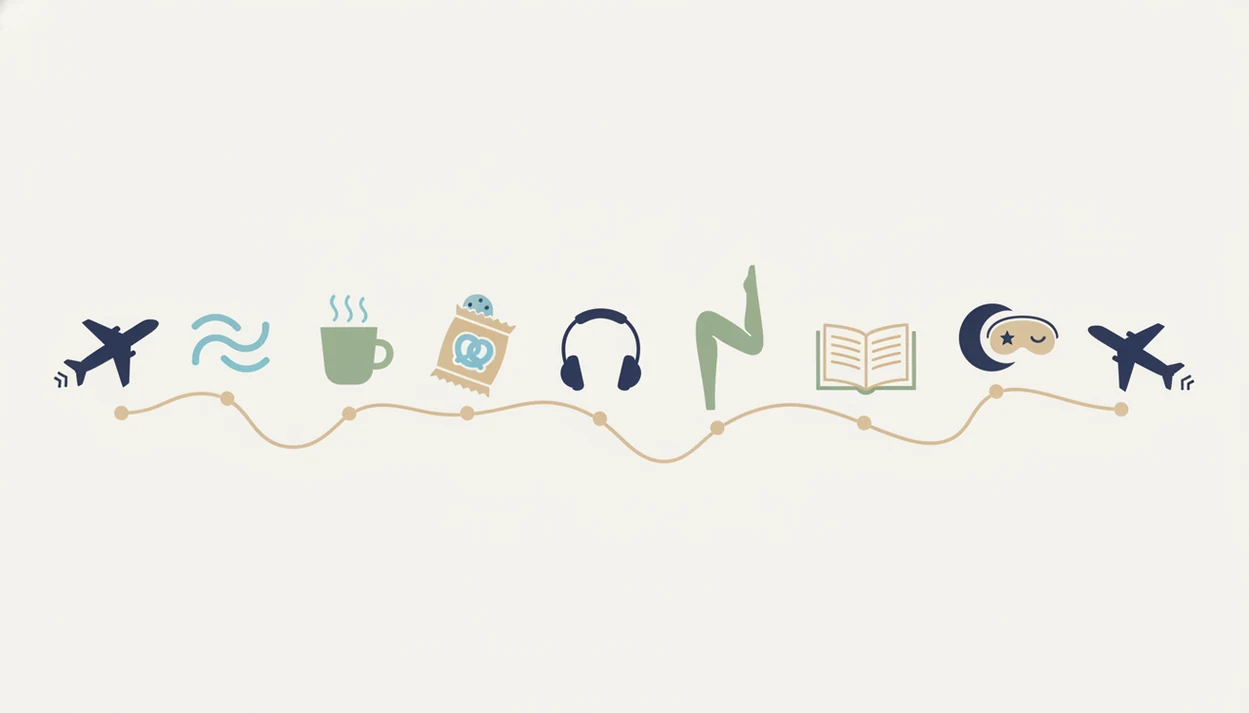
An hour-by-hour routine makes a 10-hour flight feel like a sequence of small tasks instead of one endless test. Time-blocking reduces trapped feelings because you decide less while anxious.
| Time block | Main job | Backup if anxious |
|---|---|---|
| Boarding to takeoff | Set up seat area, start calm audio | Read coping card once |
| Hour 1 | Let takeoff settle, sip water | Use grounding through senses |
| Hours 2 to 3 | First meal and easy movie | Puzzle or simple phone game |
| Hour 4 | Aisle walk if safe | Calf raises in seat |
| Hours 5 to 7 | Sleep window or eyes-closed rest | Body scan, low-volume playlist |
| Hour 8 | Snack, water, journal notes | Write “what has passed already” |
| Hours 9 to landing | Pack slowly, prepare descent | Use landing script |
Variety matters. Passive entertainment, active tasks, mindfulness, journaling, puzzles, and rest use different parts of attention. Tools like Fear of Flying Guide, SOAR, and airline fear-of-flying courses can also help you build this routine before the trip.
Step 4: Protect Sleep, Hydration, And Movement On Long Haul Flights
Sleep, hydration, and movement are anxiety tools on long-haul flights because an exhausted, dry, stiff body sends more danger signals. You are not just calming your thoughts; you are managing endurance.
- Cabin dryness can worsen discomfort: Sip water steadily rather than waiting until your mouth feels like paper.
- Caffeine and alcohol have tradeoffs: Caffeine can raise jitteriness, and alcohol can worsen hydration, sleep quality, and judgment.
- Partial sleep still counts: Two 45-minute rests may be more realistic than one heroic six-hour sleep.
- Movement matters: The WHO notes that prolonged immobility during travel is associated with increased venous thromboembolism risk, especially on flights over four hours (https://www.who.int/news/item/29-06-2007-who-research-into-global-hazards-of-travel-wright-project).
- Calf raises are useful when aisles are blocked: Lift heels, flex ankles, and change position while seated.
A 2007 paper estimated long-haul travel may raise venous thromboembolism risk about 2.8 times above baseline. Most travelers remain low risk, but medical risk factors deserve clinician advice before departure.
Step 5: Choose Treatment Options For Repeated Long Flight Anxiety
Repeated long flight anxiety often needs more than a better playlist. Clinicians typically recommend evidence-based anxiety treatment, especially CBT and exposure-based work, when fear causes avoidance, panic attacks, or major disruption.
- CBT: Cognitive behavioral therapy helps you test feared predictions, reduce safety behaviors, and build more accurate responses to body sensations.
- Exposure therapy: Gradual, repeated practice helps the brain learn that anxiety can rise and fall without escape.
- Fear-of-flying courses: Some courses combine pilot education, aircraft explanations, and anxiety exercises.
- Clinician-guided medication: Medication may help some people, but it should not be improvised on travel day or mixed casually with alcohol or sedatives.
- Trauma-informed care: A frightening flight, medical scare, or past trauma may need a slower plan.
The most common medically supported way to reduce specific phobia patterns is exposure-based treatment combined with cognitive and body-based coping skills. A broader overcome fear of flying roadmap can help you choose a next step.
Evidence Behind Long Flight Anxiety Coping Tools
The strongest evidence for long flight anxiety coping tools comes from treating specific phobias with CBT and exposure therapy. Seat routines, playlists, hydration, and movement are practical supports, but they are not studied as directly for long-haul fear itself.
- Separate treatment from comfort: CBT and exposure target the fear loop by testing predictions, reducing safety behaviors, and practicing feared cues until the brain learns “anxious” does not mean “unsafe.”
- Use aviation education carefully: Learning how turbulence, sounds, and wing movement work can reduce surprise, but facts alone may not calm a body already in panic.
- Treat medication as clinical: Anti-anxiety medication or sleep aids should be planned with a clinician, especially because alcohol, sedatives, medical conditions, and cabin dehydration can change risk.
- Keep comfort tactics honest: Breathing, grounding, movies, snacks, layers, and a coping card can make the flight more bearable, even when the direct research is thinner.
- Respect mobility evidence: Travel-medicine guidance supports movement during long immobility, especially for clot-risk reduction; it is an endurance and health tool, not a phobia cure.
Evidence is still limited for the exact question nervous flyers ask: how to reduce fear across a 10- to 15-hour flight. That is why the best plan combines clinical methods with practical cabin habits.
Common Long Haul Nervous Flyer Mistakes
The most common long-haul nervous flyer mistakes are waiting too long to use skills and relying on one coping method. Distraction helps, but it is not a full flight-day plan.
Watch for these patterns: skipping food because your stomach feels nervous, barely drinking water to avoid the bathroom, staying seated for hours, doom-scrolling aviation stories, and using alcohol as the main sedative. Over-the-counter sleep aids and sedatives can also cause grogginess, dry mouth, confusion, or poor sleep quality for some people.
Another trap is reassurance checking. The flight map, crew facial expressions, engine pitch, and wing movement can become a loop. The overhead bin latch softly rattling does not need a court case in your head. If wing movement scares you, learning why airplane wings bend once before travel is usually better than checking repeatedly mid-flight.
Start breathing before panic peaks. Early skills are quieter, but they work better.
Long Flight Anxiety Progress Check After Landing
After landing, review the flight before the details blur. Success means you completed the flight with skills, not that you felt perfectly calm.
Open the Notes app while waiting for bags and answer six prompts: What triggered me? What helped? What did I check too often? Did I eat and drink enough? Did I move? What will I change next time? Keep it short. Three useful bullets beat a dramatic diary entry.
Maybe the memory of a previous rough descent still showed up. Maybe you still boarded. Both facts matter. For a long-haul nervous flyer, progress is often measured in shorter panic spikes, fewer reassurance loops, and quicker recovery after turbulence.
Update your coping card within 24 hours. If distress stayed severe, if you avoided important travel, or if panic felt unmanageable, consider CBT, exposure therapy, or trauma-informed support before booking the next route.
Limitations
A long-haul coping plan can make flying more manageable, but it is not a guaranteed cure. Some situations need individualized medical or mental health care.
- No breathing, distraction, or planning tool works instantly for everyone.
- Severe panic, trauma history, claustrophobia, or panic disorder may need professional treatment.
- Medical conditions, pregnancy, clot risk, or medication questions should be discussed with a clinician.
- Reassurance, flight tracking, and repeated crew questions can become compulsive safety behaviors for some people.
- Alcohol, sleep aids, and ad hoc sedatives can worsen grogginess, hydration, judgment, or sleep quality.
- Exposure-based treatment usually takes time and repetition, not one practice flight.
- Aviation education helps many nervous flyers, but facts alone may not calm a sensitized body.
- This article is educational and does not replace medical or mental health advice.
FearOfFlying.com can be a practical starting point for education and coping tools, but severe or complex anxiety deserves a tailored plan.
FAQ
How do I get through a long flight when I’m anxious?
Break the flight into blocks for takeoff, meals, entertainment, movement, rest, and landing. Use calming tools early, drink water, eat something plain, and move when it is safe.
Why do long flights scare me more than short flights?
Long flights can intensify trapped feelings, loss of control, claustrophobia, turbulence fear, fatigue, and anticipatory anxiety. The length of the flight makes coping feel like an endurance problem.
Can a long-haul flight trigger a panic attack?
Yes, panic can happen on a long-haul flight, especially if you feel trapped or overtired. Slow your breathing, ground through your senses, relax large muscles, and remind yourself that panic symptoms usually rise and fall.
What helps panic on a plane during takeoff or turbulence?
Slow breathing, grounding, shoulder and jaw release, a written coping card, and simple crew support can help. Keep the request specific, such as asking for a brief reminder that the bumps are expected.
Is turbulence dangerous on long-haul flights?
Turbulence is usually uncomfortable rather than a sign of imminent danger. Wearing your seatbelt when seated is still important because sudden movement can cause injuries.
Should I take medication before a long flight?
Discuss medication with a clinician before travel day. Do not experiment with sedatives, sleep aids, alcohol combinations, or new doses during the flight.
How can I sleep on a long flight when I feel anxious?
Use a simple routine with an eye mask, earplugs, lower screen brightness, and a realistic goal of partial rest. Avoid late caffeine if it makes your anxiety or sleep worse.
How often should I walk or move on a long-haul flight?
Move during cruise when the seatbelt sign is off, and use calf raises or ankle circles when you cannot leave your seat. Avoid staying completely still for long stretches.
Can CBT help with long-haul flight anxiety?
Yes, CBT and exposure therapy can help many nervous flyers reduce fear over time. They work by changing threat predictions, reducing safety behaviors, and practicing feared situations gradually.