
Do Fear Of Flying Apps Help Or Just Reassure Nervous Flyers?
Yes, fear of flying apps can help some nervous flyers, but they work best as skill-practice tools rather than instant cures. The honest answer to “do fear of flying apps help” is that apps with CBT, education, exposure, or VR features are more evidence-aligned than apps that only distract or reassure you.
Definition: A fear of flying app is a digital tool that uses flight education, anxiety skills, CBT-style exercises, tracking, relaxation, or exposure practice to help nervous flyers manage anxiety before and during flights.
TL;DR
- Apps may reduce flight anxiety when they teach CBT skills, explain turbulence, or support gradual exposure.
- The strongest evidence is for CBT and virtual reality exposure, not for most individual commercial app brands.
- Severe aviophobia, panic attacks, or avoidance usually need a therapist-led plan rather than an app alone.
Fear of Flying App Definition for Skeptical Buyers
A fear of flying app is a support tool, not a cure, and it does not make the aircraft safer. It tries to change what your brain does with flying cues, such as engine sounds, banking, turbulence, boarding calls, and the urge to escape.
Most apps combine psychoeducation, CBT-style prompts, breathing timers, flight tracking, turbulence explanations, and sometimes VR exposure. The useful ones give you one small job for your body and one clear thought to test. The weaker ones mostly offer reassurance, playlists, or distraction.
The support-tool-versus-cure distinction matters. If your safety card is held in damp fingers before takeoff, an app may help you follow a prepared sequence. But it cannot erase severe phobia in one flight, and it should not replace care when your life is shrinking around avoidance.
At-a-Glance Answer: Are Flight Anxiety Apps Effective?
Are flight anxiety apps effective? They can be useful for mild to moderate flying anxiety, especially when they teach repeatable skills before travel. They are less reliable for severe phobia, panic attacks, or years of cancelled trips.
CBT and VR exposure have stronger evidence than most brand-specific app claims. Clinical guidance for phobias commonly emphasizes CBT and gradual exposure because those methods target avoidance, not just distress source. If you are comparing tools, use the table below before you pay for a subscription or download fear of flying app options the night before a 6:40 a.m. flight.
| app feature | likely value | evidence strength | best for |
|---|---|---|---|
| CBT thought record | High | Stronger | Catastrophic predictions |
| Flight education | Medium to high | Moderate | Misread noises and movement |
| VR exposure | High | Stronger | Gradual practice before flights |
| Breathing timer | Medium | Supportive | Body alarm during spikes |
| Reassurance alerts | Mixed | Weak | Short-term calming only |
Five Facts About Fear of Flying App Evidence
- CBT, psychoeducation, relaxation, and gradual exposure are the common active ingredients in evidence-aligned fear of flying apps.
- A Dutch randomized trial of smartphone CBT plus VR found a large reduction in flight anxiety symptoms, with Cohen’s d about 1.2 compared with waitlist source.
- A meta-analysis of VR exposure for specific phobias found significant symptom reductions, with effects similar to in-vivo exposure. source.
- Mobile anxiety interventions show small to moderate anxiety reductions overall, but designs and study quality vary widely. source.
- Most commercial fear of flying apps do not have their own peer-reviewed trials, so “scientific” language should be checked carefully.
The most common medically supported way to reduce phobic avoidance is exposure-based CBT combined with repeated practice.
How Fear of Flying Apps Work in the Anxiety Loop
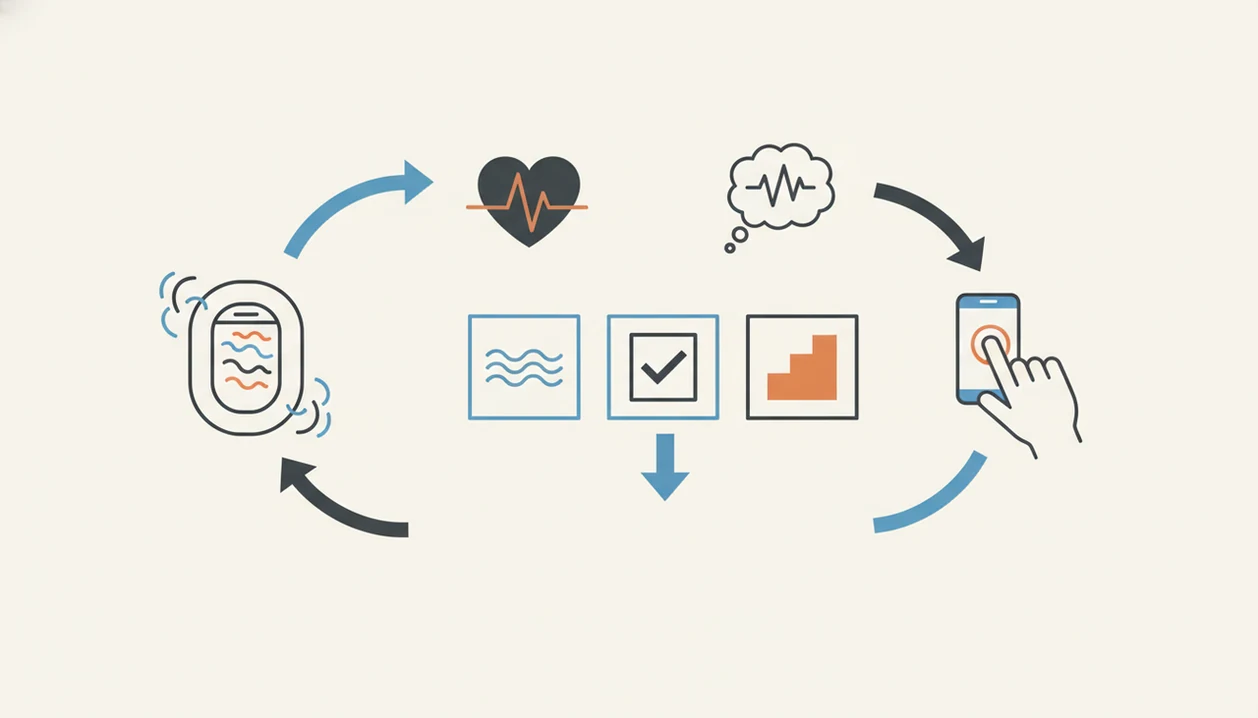
Fear of flying apps work by interrupting the anxiety loop: trigger, catastrophic interpretation, body alarm, avoidance or safety behavior, short-term relief, then stronger fear next time. In plain language, your brain learns “I survived because I escaped or checked,” not “I could tolerate that.”
A good app targets the loop at several points. Education can recode ambiguous cues, such as engine changes, banking, landing noises, or the seat belt sign chiming overhead. CBT prompts ask you to test predictions like “turbulence means danger” against a more accurate explanation. Exposure practice reduces sensitivity through repeated contact with flight images, sounds, videos, VR, or real travel steps.
Breathing tools can lower physical arousal, but they rarely create durable change by themselves. Useful breathing is a bridge back to practice, not the whole plan. Set a timer. Then do the next five minutes.
Fear of Flying App Features That Map to Evidence
Features linked to CBT or exposure are more evidence-aligned than generic relaxation or entertainment. A pretty interface matters less than what the app trains you to do when your body says, “Get out.”
| feature | therapeutic fit | buyer check |
|---|---|---|
| CBT thought records | Challenges catastrophic predictions | Are prompts specific to flying? |
| Turbulence education | Corrects misread aircraft movement | Does it explain normal flight mechanics? |
| Gradual exposure | Builds tolerance step by step | Are there levels, repeats, and review notes? |
| VR simulations | Practices feared cues before travel | Is intensity adjustable? |
| Breathing timers | Calms physiology | Is it paired with coping action? |
| Reassurance alerts | Can soothe, but may feed checking | Does use become compulsive? |
| Distraction games | Short-term relief | Does anxiety return stronger later? |
Flight tracking can help some people understand normal aircraft behavior, but it can become compulsive checking. Before paying, check clinician involvement, a university or airline program connection, published studies, offline access, and a transparent privacy policy. For a feature-by-feature comparison, the best fear of flying app guide is the better next step.
How to Use a Fear of Flying App Before and During a Flight
Use a fear of flying app as a planned practice tool, not a last-minute rescue button. The goal is to rehearse skills before your nervous system is already shouting over the boarding announcements.
- Choose one evidence-aligned app two to four weeks before travel, then stop shopping. Pick the tool that best matches your fear pattern: catastrophic thoughts, turbulence misreadings, airport panic, or avoidance.
- Practice one CBT prompt and one breathing exercise on ordinary days. Do this when you are only mildly tense so the sequence is familiar before takeoff.
- Build a short exposure ladder with flight sounds, takeoff videos, VR scenes, airport drop-offs, or watching departures. Repeat each step until it feels tolerable enough to move up, not perfectly calm.
- Download offline tools and write a two-minute takeoff coping card. Include one body action, one accurate thought, and one instruction for the first engine surge.
- Use the app at scheduled moments: the night before, at the gate, during taxi, after takeoff, and after landing. Avoid opening it every few minutes for reassurance.
- Review what you tolerated after landing, then adjust the next practice step while the evidence is still fresh.
Examples of Fear of Flying Apps and Tool Types
Fear of flying tools are easier to judge by category than by app-store rank. A high rating can mean users liked the tone, not that clinical outcomes were measured.
- Pilot-explanation apps: These explain noises, turbulence, takeoff, landing, and weather. They can reduce misinterpretation, but they cannot prove your personal flight will feel calm.
- CBT self-help apps: These guide thought records, fear ladders, and if-then scripts. They can support practice, but severe avoidance often needs a therapist.
- VR exposure apps: These simulate airport and flight cues. They can support desensitization, but intensity must be paced.
- Turbulence or flight-tracking apps: These explain conditions and aircraft movement. They can educate, but may feed checking.
- General anxiety or breathing apps: These help body regulation. They usually do not teach aviation-specific fear correction.
Tools like Fear of Flying Guide, SOAR, and Fly Confident can fit different parts of a plan, but a careful buyer should ask what each tool actually trains.
Fear of Flying Apps Versus Reassurance Checking
Reassurance feels helpful because anxiety drops quickly, but repeated checking can teach the brain that uncertainty is dangerous. That is the trap. The app starts as support, then becomes the thing you believe you must have to board.
Skill-building use looks boring on purpose: scheduled practice, one preflight review, one in-flight coping plan, and one post-flight reflection. Reassurance checking looks different. It means refreshing turbulence maps, crash statistics, weather, seat maps, or aircraft data until your phone is half-charged and your boarding pass in Apple Wallet has been opened twenty times.
A comprehensive fear of flying resource should explain causes, treatments, coping strategies, and tools for nervous flyers, not sell the fantasy that one alert can remove uncertainty. If the app becomes a requirement to board, it may be functioning as a safety behavior.
When a Fear of Flying App Helps and When Therapy Is Better
When does a fear of flying app help, and when is therapy better? Apps may be reasonable for mild to moderate nervousness, first-time coping skill practice, or relapse prevention after prior therapy.
Use an app when you can still book the trip, reach the airport, and follow a flight-day plan. Pack this before you leave: a Notes app coping card, downloaded audio, gum in the front pocket, and one if-then script for takeoff. For example, “If the engines spool and my chest tightens, then I put both feet down and read my card for two minutes.”
Therapy is usually better for flight avoidance, panic attacks, trauma history, complex anxiety, substance reliance, or cancelled trips. Exposure-based CBT, therapist-guided VR, and medical consultation may be needed for severe cases. Fear of Flying Guide can sit beside treatment as an educational tool, but high impairment needs human support.
If you have chest pain, fainting, substance use to board, or panic symptoms that feel medically unsafe, treat the app as secondary and contact a clinician before relying on self-guided exposure.
For severe flight avoidance, therapist-guided exposure is often safer than app-only practice because pacing and panic responses can be adjusted in real time.
Common Myths About Fear of Flying Apps
Several myths lead nervous flyers to overpay, under-practice, or blame themselves when an app does not “fix” the flight.
Myth 1: Any fear of flying app can cure severe aviophobia quickly. Correction: severe aviophobia usually needs gradual exposure, CBT, and sometimes professional care.
Myth 2: Turbulence or safety-tracking tools make the flight objectively safer. Correction: they may change your interpretation, but they do not change the aircraft’s actual safety.
Myth 3: Meditation alone usually resolves fear of flying permanently. Correction: meditation can help your body settle, but lasting change usually needs CBT or exposure practice.
Myth 4: Clinically proven app-store language always means peer-reviewed evidence. Correction: many claims are based on related anxiety research, not trials of that exact product.
If you want a structured alternative, a fear of flying course may offer more sequence and accountability than a stand-alone app.
Limitations
Fear of flying apps have real limits, and those limits matter most when anxiety is intense.
- Peer-reviewed evidence is limited for most individual commercial fear of flying apps.
- Many claims are extrapolated from general CBT, anxiety-app, or VR exposure research.
- Self-guided apps may be insufficient for severe aviophobia, panic disorder, PTSD, substance misuse, or complex mental health histories.
- Relaxation-only or distraction-only apps may reduce short-term distress without changing long-term avoidance.
- Apps require practice before the flight; downloading one at the gate is unlikely to be enough.
- VR can cause motion sickness or feel too intense for some users.
- Privacy, data sharing, subscription pricing, and offline access matter during real travel.
- Flight tracking can help education, but it can also become a checking ritual.
Before you open the airline app again, decide what the tool is for. Practice, not panic-refreshing. If you need a broader starting point, FearOfFlying.com works as a nervous flyer guide for causes, treatments, coping strategies, and tools.
FAQ
Do flying anxiety apps work?
Flying anxiety apps can help some users, especially when they include CBT, flight education, exposure practice, or planned coping tools. Results vary by fear severity, practice time, and app quality.
Which app features matter most?
CBT exercises, psychoeducation, gradual exposure, VR practice, and written coping plans matter more than pure distraction. Offline access is also important during real travel.
Can apps cure aviophobia?
Apps rarely cure severe aviophobia alone. They are better understood as support tools that may complement therapy or structured exposure practice.
Is VR helpful for flying fear?
VR exposure has supportive evidence for specific phobias, including fear of flying programs. It works best when the exposure is gradual and repeated.
Are turbulence apps reassuring?
Turbulence apps can educate nervous flyers about normal aircraft movement. They can also become compulsive reassurance checking if used repeatedly to seek certainty.
Should I use an app in flight?
Use an app in flight only after practicing before travel. Check that the key tools work offline before boarding.
When should I choose therapy instead of an app?
Choose therapy for severe avoidance, panic attacks, trauma history, cancelled trips, substance reliance, or major life disruption. An app can still support homework between sessions.
Are app reviews reliable evidence?
App-store reviews show user satisfaction, not clinical effectiveness. Peer-reviewed studies, clinician involvement, and transparent methods are stronger evidence than star ratings.